ART TRACKERSConnecting fine art to people
Platform OverviewPlatform SecurityPricingTechnology OverviewTags & PlaquesWhat is UAINLegal & Compliance
GovernmentTribal NationsArtistsUniversity & CollegesServices
InstitutionsExploreMuseum Collections
Artists
Why Art TrackersAboutContactBlogDocumentationCareers
Request demo
Platform OverviewPlatform SecurityPricingTechnology OverviewTags & PlaquesWhat is UAINLegal & Compliance
GovernmentTribal NationsArtistsUniversity & CollegesServices
InstitutionsExploreMuseum Collections
Artists
Why Art TrackersAboutContactBlogDocumentationCareers
Request demo
Art Trackers logo
ART TRACKERS
Connecting fine art to people

Connecting fine art to people. Preserving cultural legacy through technology.

Platform

FeaturesHow It WorksSecurityIntegrations

Government

For Cities & CountiesComplianceResourcesCase Studies

Resources

DocumentationHelp CenterBlog

Company

About UsCareersNewsContact Us

© 2026 Art Trackers LLC. All rights reserved.

Privacy PolicyTerms of ServiceAccessibility
    Museum collections / The Cleveland Museum of Art
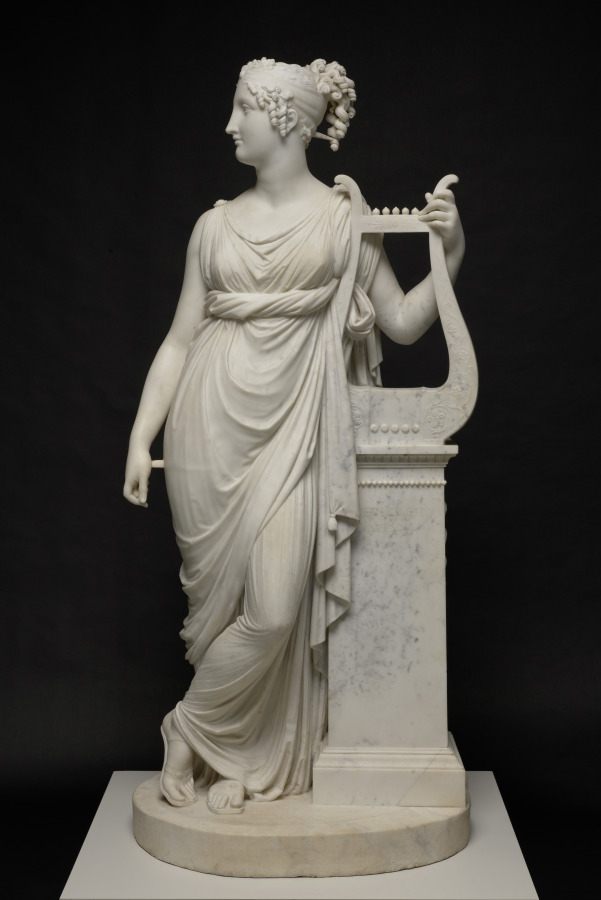
    Terpsichore Lyran (Muse of Lyric Poetry)
    Antonio Canova. Terpsichore Lyran (Muse of Lyric Poetry), 1816. The Cleveland Museum of Art. Public domain (CC0).
    AT-00000283

    Public data from the Cleveland Museum of Art. Learn more

    Terpsichore Lyran (Muse of Lyric Poetry)

    by Antonio Canova

    Also known as: Terpsichore, Muse of Choral Song and Dance; Terpsichore

    About the Artwork

    In Greek mythology, Terpsichore was one of the nine Muses, or goddesses of creative inspiration. The lyre, the Greek inscription on the short column, and the caduceus (entwined snakes) on the side identify the figure as Terpsichore Lyran, muse of lyric poetry. This sculpture began with a commission from Napoleon's brother, Lucien, for an idealized portrait of his wife, Alexandrine. Antonio Canova made this version for a British aristocrat and exhibited it in 1817 at the Royal Academy in London to great acclaim.

    Inscriptions

    inscribed on front of column: "Terpsichore Lyran" [Terpsichore as the Muse of lyric poetry]; inscribed at base of column: "Canova Fact: 1816"

    Provenance

    Simon H. Clarke, 9th Bt., 1764-1832 (Oak Hill, East Barnet, England); Alfred de Rothschild, 1842-1918 (Halton, Buckinghamshire, England), by inheritance to his nephew, Lionel de Rothschild, 1918; Lionel Nathan de Rothschild, 1882-1942 (Exbury, Hampshire, England), 1918-1942, by inheritance to his first son, Edmund Leopold de Rothschild, 1942; Edmund Leopold de Rothschild, born 1916 (Exbury, Hampshire, England), sold to Wildenstein & Co., 1963; Wildenstein & Co. (New York, New York), sold to the Cleveland Museum of Art, 1968. 1968-: The Cleveland Museum of Art, Cleveland, OH

    Exhibition history

    Year in Review for 1968. The Cleveland Museum of Art, Cleveland, OH (organizer) (January 29-March 9, 1969). Canova: Sketching in Clay. National Gallery of Art, Washington, DC (organizer) (June 11-October 9, 2023) https://www.nga.gov/exhibitions/2023/canova-sketching-in-clay.html.

    Quick Overview

    Artist
    Antonio Canova (Italian, 1757–1822)
    Date
    1816
    Medium
    marble
    Dimensions
    Overall: 177.5 x 78.1 x 61 cm (69 7/8 x 30 3/4 x 24 in.)
    Type
    Sculpture
    Classification
    Sculpture
    Department
    Modern European Painting and Sculpture
    Credit line
    Leonard C. Hanna Jr. Fund
    Accession no.
    1968.212

    More by Antonio Canova in museum collections

    • Bust of Paris

      Antonio Canova

      1809 · Sculpture

      Public collection via the Art Institute of ChicagoAT-00001928
    • Head of Medusa

      Antonio Canova

      c. 1801 · Sculpture

      Public collection via the Art Institute of ChicagoAT-00001988
    • Cupid and Psyche

      Antonio Canova

      1794 · Sculpture

      Public collection via the Metropolitan Museum of ArtAT-00016622
    • Venus and Cupid

      Antonio Canova

      1798–99 · Sculpture

      Public collection via the Metropolitan Museum of ArtAT-00016815

    Open-access museum data

    This record comes from the open-access collection data that the Cleveland Museum of Art publishes for unrestricted use (Creative Commons Zero). Art Trackers shows a selection of the museum's published fields. The Cleveland Museum of Art is not an Art Trackers client and has not reviewed or endorsed this page; the museum's own website is the authoritative record.

    • View this work at the Cleveland Museum of Art
    • The Cleveland Museum of Art: open-access terms

    Data retrieved from the Cleveland Museum of Art on October 7, 2026. The museum may have updated its record since.

    Open-access museum record · AT-00000283

    Powered by Art Trackers