
Public collection via the Cleveland Museum of Art
AT-00009172John the Baptist
About the Artwork
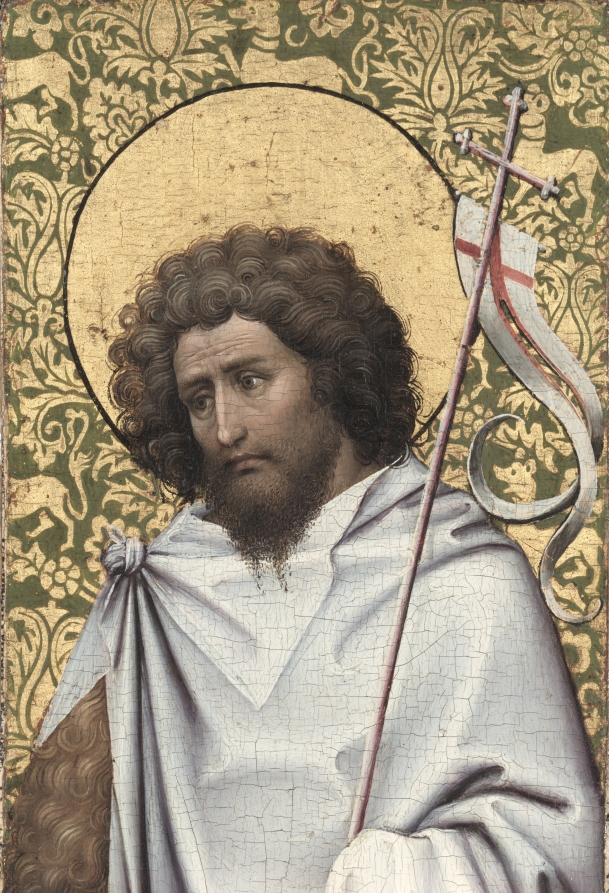
According to tradition, John the Baptist wears a hair shirt under a white cloth, associated with newly baptized Christians. The flag bearing a red cross symbolizes resurrection. In marked contrast, the background features a lavish gold-patterned silk. The display of such luxurious fabrics continues an ancient tradition of using the finest objects in the worship of God. This painting has been cut down along the lower edge and would have originally shown a full-length image of the saint. It was probably the right wing of a triptych, with John the Baptist gazing upon a central image of the Virgin and Child. Campin first settled in Tournai around 1405-6 as a free master of the guild of painters, and he bought citizenship there in 1410, which suggests he was born elsewhere. Although heavily indebted to contemporary masters of manuscript illumination, Campin displayed greater powers of realistic observation than any other painter before him. He was one of the first artists to experiment with the use of oil-based colors, in lieu of egg-based tempera, to achieve the brilliant color typical of this period.
Provenance
The Dukes of Clermont-Tonnerre; by descent, Nettancourt-Vaubecourt, Château Choiseul; Le Molt collection, Bourbonne-les-Bains; (Christie's London sale, June 26, 1964, no. 44); (Thomas P. Grange, London, 1966)
Exhibition history
Golden Anniversary of Acquisitions. The Cleveland Museum of Art, Cleveland, OH (organizer) (September 10-October 16, 1966). Dukes and Angels: Art from the Court of Burgundy (1364-1419). Musée des Beaux-Arts, Dijon, Dijon, France (May 27-September 15, 2004); The Cleveland Museum of Art, Cleveland, OH (organizer) (October 24, 2004-January 9, 2005). Die Geburt der Modern Malerei: Robert Campin, der Meister von Flemalle und Rogier van der Weyden. Städel Museum, Frankfurt am Main, Germany (November 21, 2008-February 22, 2009); Staatliche Museen zu Berlin, Gemäldegalerie, Germany (March 20-June 21, 2009).
Data retrieved from the Cleveland Museum of Art on October 8, 2026. The museum may have updated its record since.
Quick Overview
- Artist
- Robert Campin (Netherlandish, 1375/79–1444)
- Date
- c. 1410
- Medium
- oil on oak panel
- Dimensions
- Framed: 25 x 20 x 3 cm (9 13/16 x 7 7/8 x 1 3/16 in.); Unframed: 17.3 x 11.6 cm (6 13/16 x 4 9/16 in.)
- Type
- Painting
- Classification
- Painting
- Department
- Medieval Art
- Credit line
- Gift of the John Huntington Art and Polytechnic Trust
- Accession no.
- 1966.238
Open-access museum record · AT-00009172
Powered by Art Trackers