
Public data from the Cleveland Museum of Art. Learn more
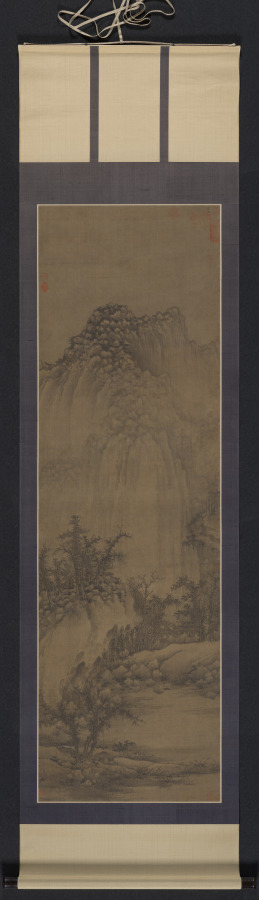
Buddhist Retreat by Stream and Mountains
by Juran
Also known as: Buddhist Retreat by Stream and Mountain
About the Artwork
Monk Juran served the Southern Tang (937–75) imperial house in Nanjing, where he studied with Dong Yuan (active 930s–60s). Both founded the southern landscape tradition, or Jiangnan school, known for gentle misty riverscapes in wet ink. Juran moved north to Kaifeng when the Southern Tang surrendered to the Northern Song, the impact of which may be seen in this painting, presumably painted after 976. A towering mountain dominates the composition, typically representing the style of the Northern Song academy; while the use of long hemp fiber strokes to texture the mountains, wet dots, and round boulders on mountain tops are elements of the southern landscape tradition.
Inscriptions
The upper portion of the scroll: the two small characters, “Ju wu 巨五”, written near the large seal. Written by a functionary in Shang Shu Sheng (the Department of State Affairs) when the painting was first received.; The upper portion of the scroll: the large seal, “Shang Shu Sheng yin 尚書省印” (seal of the Department of State Affairs); The upper portion of the scroll: the half-seal “Si yin 司印”, seen along a border. Attributed to 典禮紀察司 of Ming dynasty.
Exhibition history
The Colors of Ink. Asia House Galleries (January 10-March 3, 1974); The Cleveland Museum of Art, Cleveland, OH (organizer) (April 9-May 12, 1974). Chinese Paintings: Themes and Techniques. The Cleveland Museum of Art, Cleveland, OH (February 7-April 5, 1981). Eight Dynasties of Chinese Painting. The Nelson-Atkins Museum of Art (November 7, 1980-January 4, 1981); The Cleveland Museum of Art (February 11-March 29, 1981); Tokyo National Museum (October 4-November 17, 1982). Mountains, Rocks, and Water: Landscape Painting in Asia. The Cleveland Museum of Art, Cleveland, OH (organizer) (October 2-December 13, 1987). Asian Autumn: Masterpieces from the Collection. The Cleveland Museum of Art, Cleveland, OH (organizer) (September 17, 1991-January 5, 1992). Masterpieces of Early Chinese Painting and Calligraphy in American Collections. Shanghai Museum, Shanghai, China (organizer) (November 1, 2012-January 3, 2013). China’s Southern Paradise: Treasures from the Lower Yangzi Delta. The Cleveland Museum of Art, Cleveland, OH (organizer) (September 10, 2023-January 7, 2024).
Quick Overview
- Artist
- Juran (Chinese, active 960–985)
- Date
- 960–85
- Medium
- Hanging scroll; ink on silk
- Dimensions
- Painting only: 184.5 x 56.1 cm (72 5/8 x 22 1/16 in.); Overall with knobs: 260.5 x 77.4 cm (102 9/16 x 30 1/2 in.)
- Type
- Painting
- Classification
- Painting
- Department
- Chinese Art
- Credit line
- Gift of Katharine Holden Thayer
- Accession no.
- 1959.348
Provenance
960-1279: Song government (Shang Shu Sheng yin 尚書省印), Beijing, China 1368–98: Ming government (half-seal Si yin 司印), Beijing, China first half of 1600s: Wu Ting 吳廷 (first half of 1600s) 1620–1691: Liang Qingbiao 梁清標 [1620–1691] 1640–86: Geng Zhaozhong 耿昭忠 [1640–1686] c. 1683–c. 1744: An Qi 安岐 [c. 1683–c. 1744] 1736–95: Qing imperial collection (seals of the Qianlong Emperor), Beijing. China early 1900s: Shao Fu-hsing, Beijing, China ?–1959: (Frank F. Cho, New York, NY, sold to the Cleveland Museum of Art) 1959–: The Cleveland Museum of Art, Cleveland, OH
Data retrieved from the Cleveland Museum of Art on October 8, 2026. The museum may have updated its record since.
Open-access museum record · AT-00009373
Request removalPowered by Art Trackers