
Public data from the Cleveland Museum of Art. Learn more
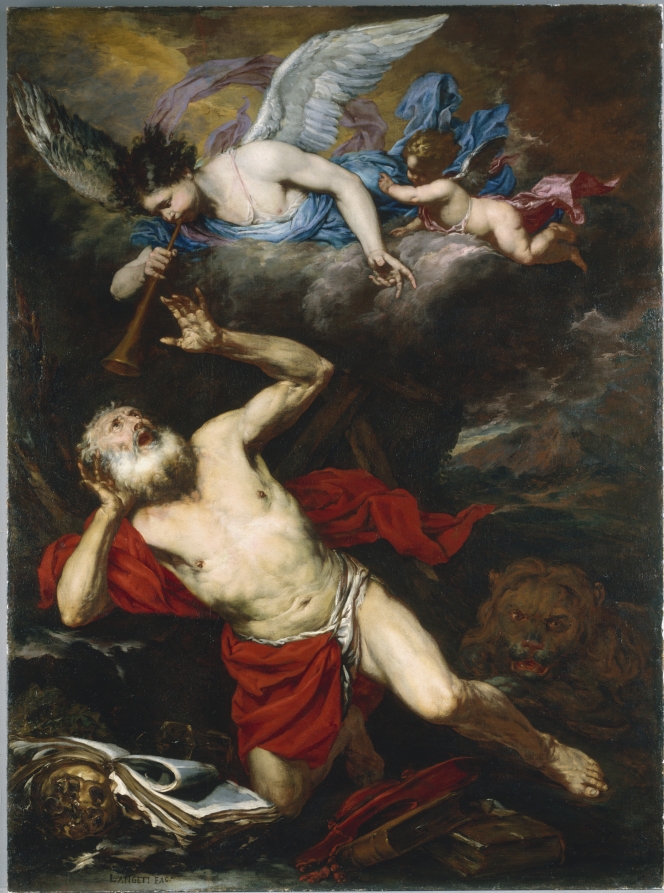
The Vision of Saint Jerome
About the Artwork
Jerome (c. 347–420 CE) studied Greek and Latin literature in Rome, but eventually pursued theology, perceiving his conduct as corrupt and sinful. Around 374 CE, Jerome had a vision of the Last Judgment in which an angel called him to task for his transgressions. Jerome then withdrew from society, learned Hebrew, and studied the Gospels, which led to his influential translations of the Bible. Langetti here follows a convention by depicting Jerome's vision after he retreated from the world. Working in the northern Italian port of Genoa, Langetti absorbed Caravaggio's impact, seen in the composition's naturalistic bodies and dramatic light.
Inscriptions
Signed lower left: "LANGETI FAC.at"
Exhibition history
Genoese Masters, Cambiaso to Magnasco, 1550-1750. Dayton Art Institute, Dayton, OH (organizer) (October 19-December 2, 1962); John and Mable Ringling Museum of Art, Sarasota, FL (January 5-February 17, 1963); Wadsworth Atheneum Museum of Art, Hartford, CT (March 19-May 5, 1963). Art in Italy, 1600-1700. The Detroit Institute of Arts, Detroit, MI (organizer) (April 6-May 9, 1965).
Quick Overview
- Artist
- Giovanni Battista Langetti (Italian, 1635–1676)
- Date
- c. 1660
- Medium
- oil on canvas
- Dimensions
- Framed: 238 x 187 x 13 cm (93 11/16 x 73 5/8 x 5 1/8 in.); Unframed: 200.2 x 149.2 cm (78 13/16 x 58 3/4 in.)
- Type
- Painting
- Classification
- Painting
- Department
- European Painting and Sculpture
- Credit line
- Delia E. Holden and L. E. Holden Funds
- Accession no.
- 1951.334
Provenance
1758: Palazzo Conti, Vicenza 1922: Italico Brass, Venice, Italy. 1951: Alessandro Brass sold to The Cleveland Museum of Art.
Data retrieved from the Cleveland Museum of Art on October 8, 2026. The museum may have updated its record since.
Open-access museum record · AT-00009482
Request removalPowered by Art Trackers