ART TRACKERSConnecting fine art to people
Platform OverviewPlatform SecurityPricingTechnology OverviewTags & PlaquesWhat is UAINLegal & Compliance
GovernmentTribal NationsArtistsUniversity & CollegesServicesProcurement
InstitutionsExploreMuseum Collections
Artists
Why Art TrackersAboutContactBlogDocumentationCareers
Request demo
Platform OverviewPlatform SecurityPricingTechnology OverviewTags & PlaquesWhat is UAINLegal & Compliance
GovernmentTribal NationsArtistsUniversity & CollegesServicesProcurement
InstitutionsExploreMuseum Collections
Artists
Why Art TrackersAboutContactBlogDocumentationCareers
Request demo
Art Trackers logo
ART TRACKERS
Connecting fine art to people

Connecting fine art to people. Preserving cultural legacy through technology.

Platform

FeaturesHow It WorksSecurityIntegrations

Government

For Cities & CountiesCompliance

Resources

DocumentationHelp CenterBlog

Company

About UsCareersNewsContact Us

© 2026 Art Trackers LLC. All rights reserved.

Privacy PolicyTerms of ServiceAccessibility
    Museum collections / The Cleveland Museum of Art
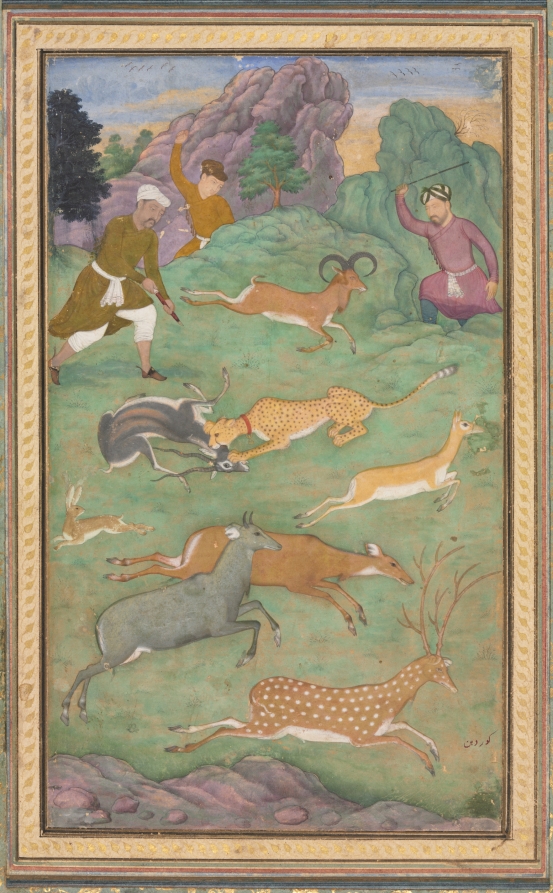
    Antelope and deer hunt by Govardhan
    Govardhan. Antelope and deer hunt, c. 1602–4. The Cleveland Museum of Art. Public domain (CC0).
    AT-00009517

    Public data from the Cleveland Museum of Art. Learn more

    Antelope and deer hunt

    by Govardhan

    Also known as: Hunting Scene

    About the Artwork

    The Mughals used trained cheetahs, such as this one wearing a red collar, to capture prey during hunting expeditions in the wilderness. The metaphor of the hunt was also a potent image in Persian literature, in which the protagonist finally achieves a desired goal. The central image of the cheetah catching the black buck—a frequently repeated visual trope—resonates with the desire of Prince Salim (who was passionate about hunting) to capture the throne of the Mughal Empire from Akbar, his father. Between 1600 and 1605, when Prince Salim set up his own royal court in defiance of his father, he convinced some imperial artists to join him. The young Govardhan, a Hindu who would go on to achieve high stature in the atelier of the next two emperors, was one of them.

    Inscriptions

    recto, lower right: Govardhan

    Exhibition history

    East Indian Art. The Detroit Institute of Arts, Detroit, MI (organizer) (February 10-March 29, 1942). Art and Stories from Mughal India. The Cleveland Museum of Art, Cleveland, OH (organizer) (July 31-October 23, 2016).

    Quick Overview

    Artist
    Govardhan (Indian, active c.1596–1645)
    Date
    c. 1602–4
    Medium
    Gum tempera and gold on paper
    Dimensions
    Image: 20 x 11.8 cm (7 7/8 x 4 5/8 in.); Overall: 37 x 25.3 cm (14 9/16 x 9 15/16 in.)
    Type
    Painting
    Classification
    Painting
    Department
    Indian and Southeast Asian Art
    Credit line
    Dudley P. Allen Fund
    Accession no.
    1939.66

    Provenance

    ?–1939: (Wells Objects of Art, Inc., New York, NY, sold to the Cleveland Museum of Art) 1939–: The Cleveland Museum of Art, Cleveland, OH

    Open-access museum data

    This record comes from the open-access collection data that the Cleveland Museum of Art publishes for unrestricted use (Creative Commons Zero). Art Trackers shows a selection of the museum's published fields. The Cleveland Museum of Art is not an Art Trackers client and has not reviewed or endorsed this page; the museum's own website is the authoritative record.

    Source: The Cleveland Museum of Art Open Access (CC0)

    • View this work at the Cleveland Museum of Art
    • The Cleveland Museum of Art: open-access terms

    Data retrieved from the Cleveland Museum of Art on October 8, 2026. The museum may have updated its record since.

    Open-access museum record · AT-00009517

    Request removal·Powered by Art Trackers