
Public collection via the Cleveland Museum of Art
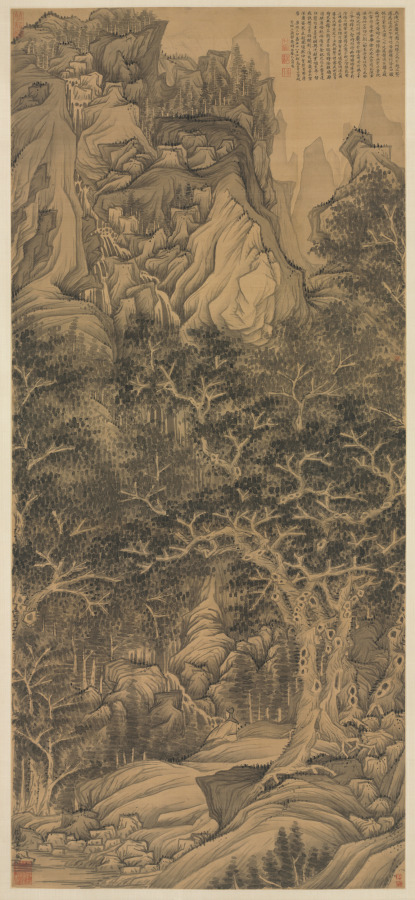
AT-00009662The Mountain of Five Cataracts
Also known as: The Mountain of the Five Cataracts; The Mountain of Five Cataracts 五泄山圖; Wu-hsieh Shan: The Mountain of the Five Cataracts
About the Artwork
A unique landscape painting in the existing body of Chen Hongshou’s art, this painting reveals his involvement with the practice of fang (imitation) to achieve creative transformation. Chen acquired the tradition stemming from Dong Yuan of the Five Dynasties, with which he sought an artistic individuality that lends his work an idiosyncratic vision and extraordinary power.
Inscriptions
Artist's signature and seal at middle right edge: Hongshou [seal] Zhanghou 洪绶 [印]章侯; Inscription by Gao Shiqi 高士奇 (1645–1704): The Mountain of the Five Cataracts is bordered by three prefectures--Wu [Jinhua], Hang [Hangzhou], and Yue [Shaoxing]--and is quite close to Jiyang [Zhuji] in Yue. The landscape there is extraordinary and precipitous, with ridges and peaks standing in circles. Rocks of strange shapes gaze down everywhere, while maple and bamboo provide shade. The water from five pools overflows and is suspended in five steps--that is why it is called "Five Cataracts." Xie Yuanqing [Xie Tiao 謝朓, c. 464–499] of the Qi Dynasty gathered medicinal herbs here; Diao Jingchun [Diao yue 刁約, 11th century] of the Song Dynasty also visited here; Song Jinhua [Song Lian 宋濂, 1310–1381] and Xu Tianchi [Xu Wei 徐渭, 1521–1593] both wrote travel notes about the place; and Chen Hongshou painted here. His mountains are done in the style of the Six Dynasties masters; the trees are after those of Dong Beiyuan [董源 Dong Yuan, active during the Five Dynasties]--the painting seems to be richly imbued with the primeval spirit. Xu Wei said that the grotto is unique for the shade (yin) and the five cataracts unusual for the sun (yang). There are seventy-two peaks, with a ravine between two cliffs. At times they are bright and at other times, gloomy; sometimes they seem to be open, sometimes closed, yet often border uniquely between shady (yin) and sunny (yang). Zhanghou [Chen Hongshou] really succeeded in capturing that spirit. As a young man indulgently boating through Shanyin [Shaoxing], I became familiar with the beauty of the Five Cataracts. The cold streams, when level, become pools clear as crystal. Pouring foam mingled with flying waterfall, Its shapes constantly changing. Water would flow downward without a sound, Or become raging billows emitting echoes. Sometimes the wind from the sky would wail, The green forest during the day would turn dark. Sometimes it was dangerous and difficult to ascend, For the moss was slippery on the stone steps in those precipitous cliffs. After reading the travel notes of Sung [Lian] and Xu [Wei], I'm afraid their descriptions are incomplete. Yet when Laolian [Chen Hongshou] was seized with the inspiration to paint, His brush and ink moved with exhilaration. It is as if mists have risen From a hot cooking pot, gradually opened. By hanging this on a plain wall, One can clearly listen to the quiet night. At the end of the year, ice and snow are deep; The cold air in the quiet studio is frozen. Near the fireplace, I make with it a silent, spiritual acquaintance Burning incense and striking a lucid qing [stone chime]. On the eighteenth day of the twelfth month in the jimao year of the Kangxi era [1699]. Jiangcun, Gao Shiqi. Zhuchuang inscribed this at Zhe in the Lan Jing studio. It was the third day after the beginning of spring. trans. LYSL/HK/WKH; Collector's inscription by Gao Shiqi 高士奇 (1645–1704), one column in standard script at the lower left corner: 信天巢秘藏; 5 seals of Gao Shiqi 高士奇 (1645–1704): 竹窗 Zhu Chuang; 高士奇 Gao Shiqi; 澹人 Danren; 簡靜齋 Jian Jing Zhai (Gao Shiqi's studio; at the upper left corner); 高氏江村草堂珍藏書畫之印 Gaoshi Jiangcun Caotang Zhencang shuhua zhi yin (at the lower left corner).; Two additional seals at the lower left and right corners are undecipherable.
Provenance
Gao Shiqi 高士奇 [1644–1703] Guan Mianjun 關冕鈞 [1870–1933] ?–1966: (Walter Hochstadter [1914–2007], New York, NY, sold to the Cleveland Museum of Art) 1966–: The Cleveland Museum of Art, Cleveland, OH
Exhibition history
Year in Review: 1967. The Cleveland Museum of Art, Cleveland, OH (organizer) (November 29-December 31, 1967). The Restless Landscape: Chinese Painting of the Late Ming Period. University of California, Berkeley. University Art Museum, Berkeley, CA (organizer) (November 9, 1971-January 2, 1972); Fogg Art Museum/Harvard University, Cambridge, MA (February 11-April 2, 1972). The Colors of Ink. Asia House Galleries (January 10-March 3, 1974); The Cleveland Museum of Art, Cleveland, OH (organizer) (April 9-May 12, 1974). Asian Autumn: Masterpieces from the Collection. The Cleveland Museum of Art, Cleveland, OH (organizer) (September 17, 1991-January 5, 1992). Repentant Monk: Illusion and Disillusion in the Art of Chen Hongshou (1599-1652). University of California, Berkeley Art Museum and Pacific Film Archive, Berkeley, CA (organizer) (October 25, 2017-January 28, 2018).
Data retrieved from the Cleveland Museum of Art on October 8, 2026. The museum may have updated its record since.
Quick Overview
- Artist
- Chen Hongshou (Chinese, 1598/99–1652)
- Date
- c. 1630
- Medium
- hanging scroll; ink on silk
- Dimensions
- Painting: 118 x 53 cm (46 7/16 x 20 7/8 in.); Overall: 232.4 x 69.7 cm (91 1/2 x 27 7/16 in.)
- Type
- Painting
- Classification
- Painting
- Department
- Chinese Art
- Credit line
- John L. Severance Fund
- Accession no.
- 1966.366
More by Chen Hongshou in museum collections
Open-access museum record · AT-00009662
Powered by Art Trackers