
Public collection via the Cleveland Museum of Art
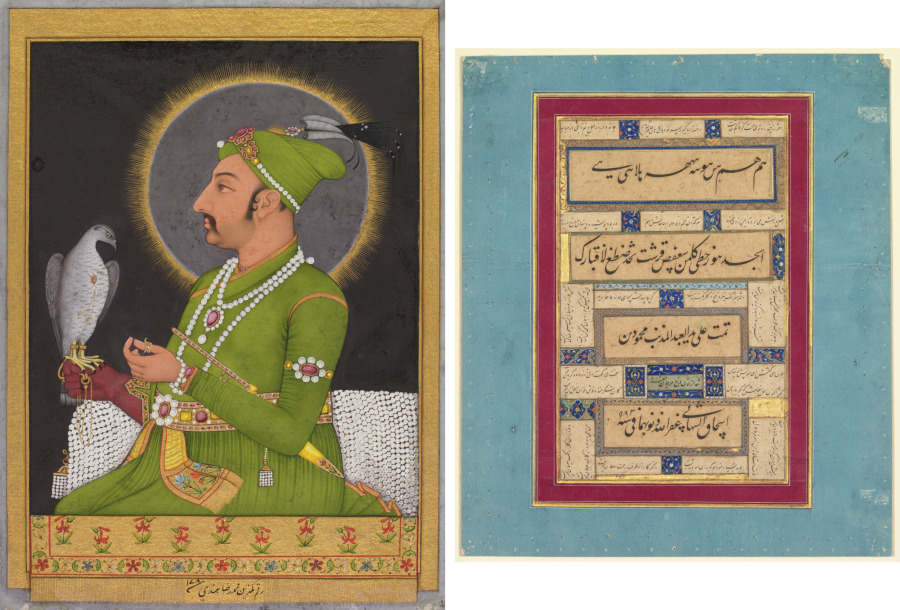
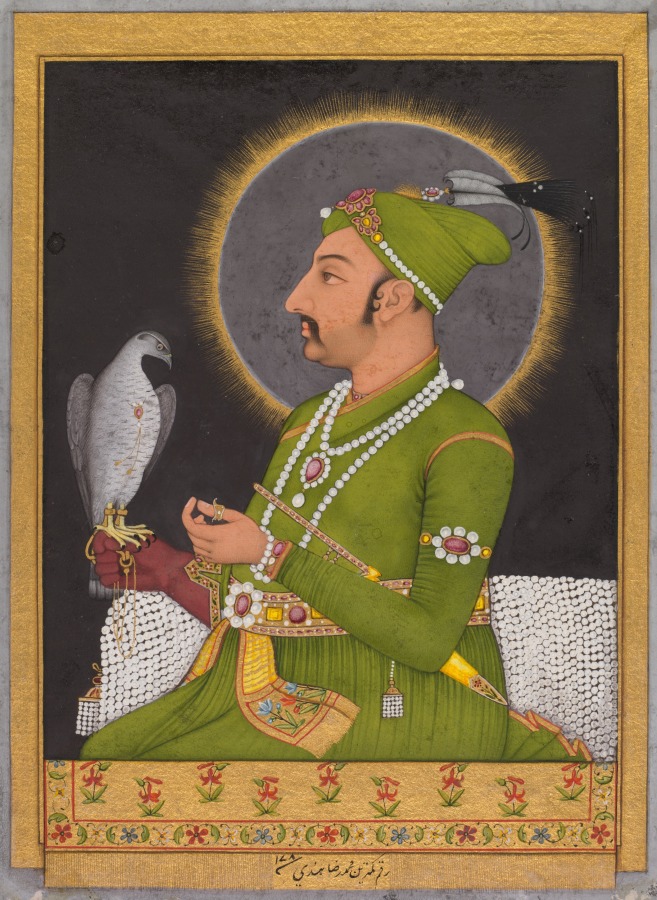
AT-00009685Posthumous portrait of the Mughal emperor Muhammad Shah (reigned 1719–1748) holding a falcon (recto); Calligraphy (verso)
Also known as: Posthumous Portrait of the Mughal Emperor Muhammad Shah (r. 1719-1748) Holding a Falcon (recto); Calligraphy (verso)
About the Artwork
Emperor Muhammad Shah, who reigned from 1719 to 1748, was known as “Rangila,” which means “the Colorful.” The innovative use of a black background sharply sets off the chartreuse green of his jama and the pearls of his adornments and bolster. On his left thumb he wears an archer’s ring, and a stabbing dagger is tucked into his bejeweled belt. Even his trained hunting falcon has a ruby necklace. In this formal posthumous portrait, the master artist conveys a heightened realism that emerges effortlessly from elegant contour lines and bold use of color. The work was part of an album of paintings collected in India before 1811 by a Scottish politician who worked for the British East India Company.
Inscriptions
recto: Persian inscription in top margin, in nasta‘liq script. Picture of Muhammad Shah, the Great Warrior King; recto: Persian inscription at bottom center of painting, in nasta‘liq script. The work of the lowly Muhammad Riza, the Indian 178 [AH 1178]; verso: In center, Persian exercises including on the second line down the “abjad” letters of numeration followed by calligrapher’s signature, in nasta‘liq script. Done by the hand of the sinful slave Mahmud ibn Ishaq al-Shahabi, may God forgive his sins, in the year 982; verso: Persian verses above from a ghazal of Hafiz (Persian, 1325–1389), in nasta‘liq script. For some days now the Daughter of the Vine has been lost to us,/ Gone away to tend to her own affairs. Be alert and prepared (as a search party)./ Her dress is of rubies and she wears a tiara of delicate glass./ She carries off wisdom and knowledge. Till you feel safe and secure from her, remain alert!/ Whoever will bring her bitter presence to me, I will give him sweet confectionaries (halwa) in exchange,/ And should she be hiding in disguise in the underworld, go down (and seek her out)/ The daughter of the dark-colored (vine) is quick-tempered, petulant, rose-colored and drunk./ Should you find her, take her towards Hafiz’s house.; verso: Persian verses below, continued from above, in nasta‘liq script. I saw her last night, sauntering and tipsy./ A cup in hand, she was heading towards a gathering of the drunk/ I was so vexed that my poetic powers/ Became distraught and fled away from me/ She was harboring thoughts of Khwarazm and the shores of the Oxus/ With a thousand complaints she was leaving the Kingdom of Solomon/ Gone would be the person who knew the very soul of poetry as no one else./ I was witnessing this and my soul was seeping out of my body/ I protested and much lamented but to no avail/ For this was a matter for the Sultan’s compassion to tend.
Provenance
before 1811–1849: Sir Charles Forbes, 7th Baronet [1773–1849], Bengal, London, and Scotland, by descent to his great-grandson, Colonel Sir John Forbes ?–1962: Colonel Sir John Stewart Forbes [1901–1984], Baronet, DSO, DL, Allargue House, Strathdon, Aberdeenshire, Scotland, UK, consigned to Sotheby's London for sale December 10, 1962: (Sotheby’s, London, Western and Oriental Manuscripts and Miniatures, 10 December 1962, lot 25, sold to Ralph Benkaim) 1962–2013: Ralph Benkaim [1914–2001] and Catherine Glynn Benkaim [b. 1946], Beverly Hills, CA, sold to the Cleveland Museum of Art 2013–: The Cleveland Museum of Art, Cleveland, OH
Exhibition history
Art and Stories from Mughal India. The Cleveland Museum of Art, Cleveland, OH (organizer) (July 31-October 23, 2016).
Data retrieved from the Cleveland Museum of Art on October 8, 2026. The museum may have updated its record since.
Quick Overview
- Artist
- Muhammad Rizavi Hindi (Indian, active mid-1700s)
- Date
- 1764
- Medium
- Gum tempera, ink, and gold on paper
- Dimensions
- Painting only: 14.4 x 10.3 cm (5 11/16 x 4 1/16 in.); Page: 28 x 23.8 cm (11 x 9 3/8 in.)
- Type
- Painting
- Classification
- Painting
- Department
- Indian and Southeast Asian Art
- Credit line
- Gift in honor of Madeline Neves Clapp; Gift of Mrs. Henry White Cannon by exchange; Bequest of Louise T. Cooper; Leonard C. Hanna Jr. Fund; From the Catherine and Ralph Benkaim Collection
- Accession no.
- 2013.347
More by Muhammad Rizavi Hindi in museum collections
Posthumous portrait of the Mughal emperor Muhammad Shah (reigned 1719–1748) holding a falcon (recto)
Muhammad Rizavi Hindi1764 · Painting
Public collection via the Cleveland Museum of Art
AT-00009632
Open-access museum record · AT-00009685
Powered by Art Trackers