
Public collection via the Cleveland Museum of Art
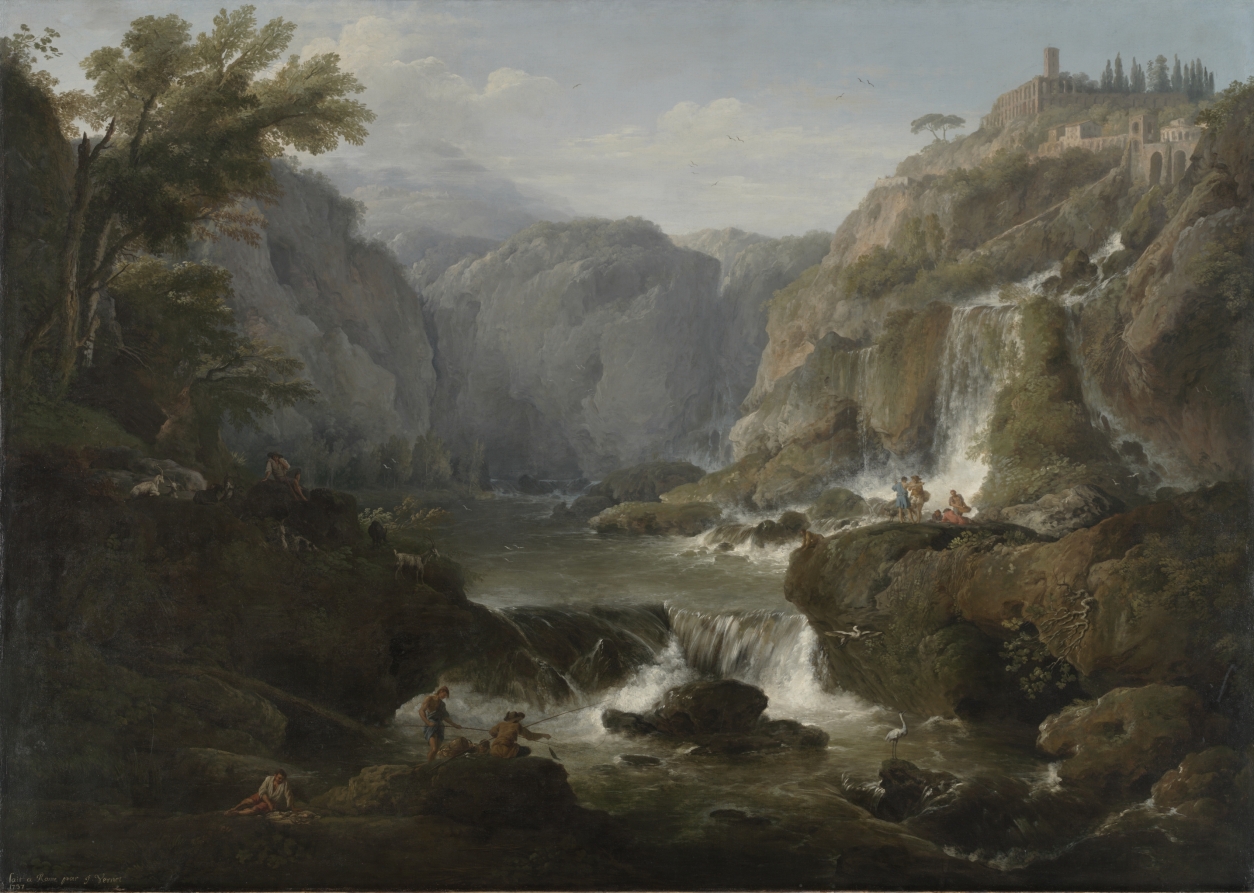
AT-00009725The Waterfalls at Tivoli
About the Artwork
Likely Vernet's first major work during his study in Rome, this landscape demonstrates his signature style. Vernet preferred and is remembered for marine subjects and water is also a central theme in this painting. Vernet became the predominant French landscape painter of the 18th century, contributing to a long French tradition. While in Rome, he absorbed the Italian tradition of dramatic, rugged landscape paintings, established by Salvador Rosa in the 1600s. This influence is reflected in Vernet's presentation of the craggy rock formations and cascades that made Tivoli, a small town twenty miles east of Rome, famous. Vernet here synthesizes this style with the calmer pastoral mode, more typical of the French landscape tradition, with its roots in the work of Claude Lorrain. Vernet generally inserted elements of humanity in his work, here evident in the touches of civilization in the background and the fishermen in the foreground. Vernet enjoyed considerable popularity, evidenced by the fact that Napoleon's brother Lucien Bonaparte held this painting as a part of his impressive collection.
Inscriptions
Signed lower left: "fait a Rome par J. Vernet"
Provenance
-1812: Prince Lucien Bonaparte (1775-1840), Ludlow, England By 1815: William Buchanan March 14, 1825: Sale: Lapeyrière, Paris, France, March 14, 1825 Boursault, sold, Paris, May 1832, through H. Artaria to Edmund Higginson 1832-1846: Edmund Higginson, 1802 - 1871 (Saltmarshe Castle, England) (sold, London, June 4-6, 1846) -1853: Lord Charles Vere Townshend, 1785 - 1853, upon his death, held in trust by the estate 1853-1854: Estate of Lord Charles Vere Townshend (sold, London, May 13, 1854); -1949: Frost & Reed (London, England), sold to Siegfried Sassoon, 1949 1949-1984: Siegfried Sassoon (sold, Sotheby's, London, 1984, to the Cleveland Museum of Art) 1984-: The Cleveland Museum of Art, Cleveland, OH
Exhibition history
Year in Review for 1984. The Cleveland Museum of Art, Cleveland, OH (organizer) (April 3-May 5, 1985).
Data retrieved from the Cleveland Museum of Art on October 8, 2026. The museum may have updated its record since.
Quick Overview
- Artist
- Claude-Joseph Vernet (French, 1714–1789)
- Date
- 1737
- Medium
- oil on canvas
- Dimensions
- Framed: 142.5 x 192.5 x 9 cm (56 1/8 x 75 13/16 x 3 9/16 in.); Unframed: 123.2 x 172.6 cm (48 1/2 x 67 15/16 in.)
- Type
- Painting
- Classification
- Painting
- Department
- European Painting and Sculpture
- Credit line
- Leonard C. Hanna Jr. Fund
- Accession no.
- 1984.175
More by Claude Joseph Vernet in museum collections

Public collection via the Art Institute of Chicago
AT-00000737
Public collection via the Art Institute of Chicago
AT-00003439
Study of a Warship's Prow with British Warships and Naples Harbor Beyond
Claude Joseph Vernetc. 1748 · Drawing
Public collection via the Art Institute of Chicago
AT-00006077
Public collection via the Cleveland Museum of Art
AT-00011246
Open-access museum record · AT-00009725
Powered by Art Trackers