
Public data from the Cleveland Museum of Art. Learn more
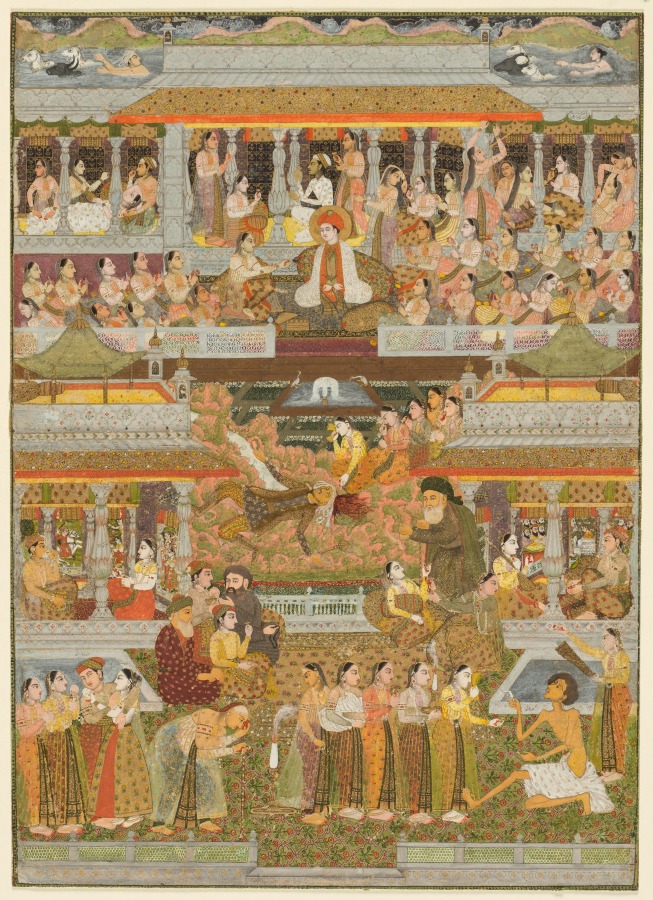
Lovers and beloveds: A composite of scenes from Persian, Urdu, and Sanskrit literature
by Chitarman II
About the Artwork
The figure of Joseph, identified by his halo, sits in the center near the top of this painting of heroes and heroines of ten different Persian, Urdu, and Sanskrit romances. The depicted scene occurs after Joseph has been purchased by Zulaykha in Egypt. Zulaykha, wishing to show him off to her friends and acquaintances, invites them to her home where she supplies oranges and knives. When the women see Joseph, they all are so distracted by his divine beauty that they accidentally cut their hands while peeling their oranges, but remain mesmerized by his appearance. The dramatic scene in the center is from the Persian romance of Khusrau and Shirin, in which Farhad, a stonecutter who loved Shirin, threw himself to his death from a mountaintop after hearing news of Shirin’s death, falsely sent to him from his rival Khusrau. The emaciated Majnun is in the lower right corner. Every vignette has been identified with a tiny Persian inscription.
Inscriptions
Persian inscriptions throughout, in nasta‘liq script: Top left: The celebrated lover Ranjha; Top right, above awning: The notable ladies of the city falling into a swoon having caught sight of Joseph’s beauteous countenance; Top center, on pillar beneath canopy: The celebrated lover Vamiq; On another pillar, behind the woman’s head: The celebrated beloved ‘Azra; Upper left, on pillar: King Nala, the lover; Central figure with halo: The coming from the prison and sitting [in state] of the Lord Joseph the Prophet, with the women of the town cutting the palms of their hands and falling down unconscious; Left of center: [. . . cutting palms . . . wine cups fell from their hands . . . state of wonderment . . .]; Central pavilion at left: Sassi, the beloved the lover [Punnun]; Below central figure of Joseph: The stream of milk Shirin the beloved, weeping The death of Farhad, the lover; Lower right, in front of bearded man: Hafiz of Shiraz; Below his decanter: The stick of candy [referring to the woman with whom, according to popular lore, Hafiz was supposed to have fallen in love as a youth]; Behind the pavilion at right: Bride descending into a grave . . .; On the white railing to the left: Khwaja Bu Ali . . .; Bottom left: Queen Padmavati, the beloved, King Ratnasena, the lover; Bottom right: Majnun, the lover; On page held by Majnun: Say, “He is Allah, who is One, Allah the eternal refuge. He neither begets nor is born, Nor is there to Him any equivalent.” [Qur'an, chapter 112]
Provenance
?-November 1969: (Walter Randall Gallery, New York, NY, sold to Ralph Benkaim) November 1969-2013: Ralph Benkaim [1914-2001] and Catherine Glynn Benkaim [b. 1946], Beverly Hills, CA, sold to the Cleveland Museum of Art 2013-: The Cleveland Museum of Art, Cleveland, OH
Exhibition history
Art and Stories from Mughal India. The Cleveland Museum of Art, Cleveland, OH (organizer) (July 31-October 23, 2016).
Quick Overview
- Artist
- Chitarman II (Indian, c. 1680–с. 1750)
- Date
- c. 1735
- Medium
- Gum tempera and gold on paper
- Dimensions
- Painting: 41.2 x 29.6 cm (16 1/4 x 11 5/8 in.)
- Type
- Painting
- Classification
- Painting
- Department
- Indian and Southeast Asian Art
- Credit line
- Gift in honor of Madeline Neves Clapp; Gift of Mrs. Henry White Cannon by exchange; Bequest of Louise T. Cooper; Leonard C. Hanna Jr. Fund; From the Catherine and Ralph Benkaim Collection
- Accession no.
- 2013.345
More by Chitarman II in museum collections
Data retrieved from the Cleveland Museum of Art on October 8, 2026. The museum may have updated its record since.
Open-access museum record · AT-00009761
Powered by Art Trackers