
Public data from the Cleveland Museum of Art. Learn more
About the Artwork
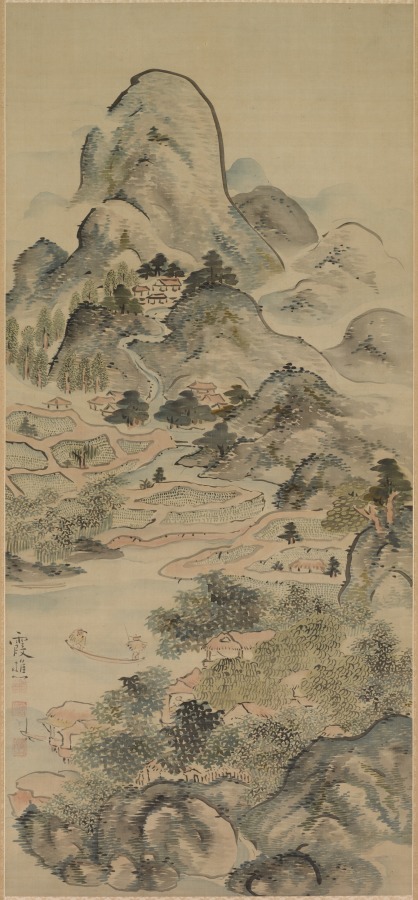
Though Ike Taiga first made a living after his father's early death by selling paintings on fans, he found a place within Kyoto's literati community and became one of its leading figures. In this colorful work, a river flows down from a mountain village, passing through farms on its way to the fishing town nestled in trees and bamboo along the banks in the foreground. Two people set out in a boat on the calm water where the river expands.
Inscriptions
Signature: 霞樵, transliteration, Kashō. Seals: 池無名印, transliteration, Ike Mumei in; 三岳道者, transliteration, Sangaku Dōja; 遵生, transliteration, Junsei.
Provenance
?–1961: (Mayuyama and Company, Tokyo, Japan, sold to the Cleveland Museum of Art) 1961–: The Cleveland Museum of Art, Cleveland, OH
Exhibition history
Year in Review (1961). The Cleveland Museum of Art, Cleveland, OH (organizer) (November 1-26, 1961). Kamakura to Edo. Art Gallery of Greater Victoria, Victoria, BC, Canada (organizer) (September 8-October 1, 1967). Suibokuga: Japanese Ink Painting. The Cleveland Museum of Art, Cleveland, OH (organizer) (October 1, 1985-February 24, 1986). Japanese Gallery 235 Rotation. The Cleveland Museum of Art (organizer) (January 2-July 9, 2018).
Quick Overview
- Artist
- Ike Taiga (Japanese, 1723–1776)
- Date
- 1700s
- Medium
- Hanging scroll; ink and color on silk
- Dimensions
- Painting: 124 x 49.4 cm (48 13/16 x 19 7/16 in.); Mounted: 210 x 62.9 cm (82 11/16 x 24 3/4 in.)
- Type
- Painting
- Classification
- Painting
- Department
- Japanese Art
- Credit line
- Edward L. Whittemore Fund
- Accession no.
- 1961.47
More by Ike Taiga in museum collections

Data retrieved from the Cleveland Museum of Art on October 8, 2026. The museum may have updated its record since.
Open-access museum record · AT-00009877
Powered by Art Trackers