
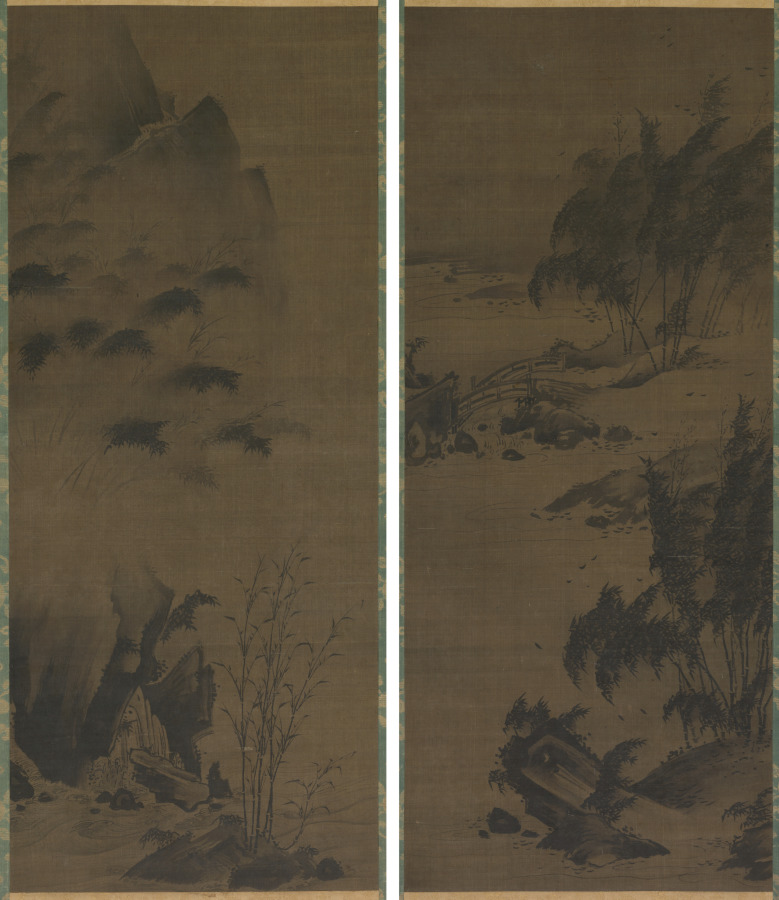
Public data from the Cleveland Museum of Art. Learn more
Bamboo in Rain; Bamboo in Wind
by Genga
About the Artwork
East Asian paintings from China, Korea, and Japan were frequently conceived as sets of multiple images. These sets might have been composed for specific palace or temple rooms, or to portray a specific theme, such as the four seasons. Over time, the original intent of such sets is often lost through damage, changes in ownership, or a variety of other reasons. The identity of the artist can also be lost, but then, sometimes, retrieved. This pair of ink paintings has traditionally been labeled as Japanese and attributed to the 16th-century painter Genga. Since there are no seals or signature of the artist on the painting, this attribution was based on comparisons of brush style with paintings known to be by Genga. More recent study indicates that while the 16th century is an appropriate time frame for the pair, the precise cultural identity of the artist is not certain after all. The dark, eccentric shapes of the rocks and bamboo clusters and the dramatic tonal contrasts evident throughout the composition point to either Korean authorship or influence upon a Japanese painter of the period.
Provenance
1975: (Sotheby Parke Bernet, Inc., New York, NY) 1975–: The Cleveland Museum of Art, Cleveland, OH
Exhibition history
Traditions and Revisions: Themes from the History of Sculpture. The Cleveland Museum of Art, Cleveland, OH (organizer) (September 24-November 16, 1975). Year in Review: 1975. The Cleveland Museum of Art, Cleveland, OH (organizer) (February 3-March 7, 1976). Byobu: The Art of the Japanese Screen. The Cleveland Museum of Art, Cleveland, OH (organizer) (December 8, 1987-January 10, 1988).
Quick Overview
- Artist
- Genga (Japanese)
- Date
- early 1500s
- Medium
- hanging scroll; ink on silk
- Type
- Painting
- Classification
- Painting
- Department
- Japanese Art
- Credit line
- Gift in memory of Mrs. Samuel Savage
- Accession no.
- 1975.71
Data retrieved from the Cleveland Museum of Art on October 8, 2026. The museum may have updated its record since.
Open-access museum record · AT-00009954
Powered by Art Trackers