
Public data from the Cleveland Museum of Art. Learn more
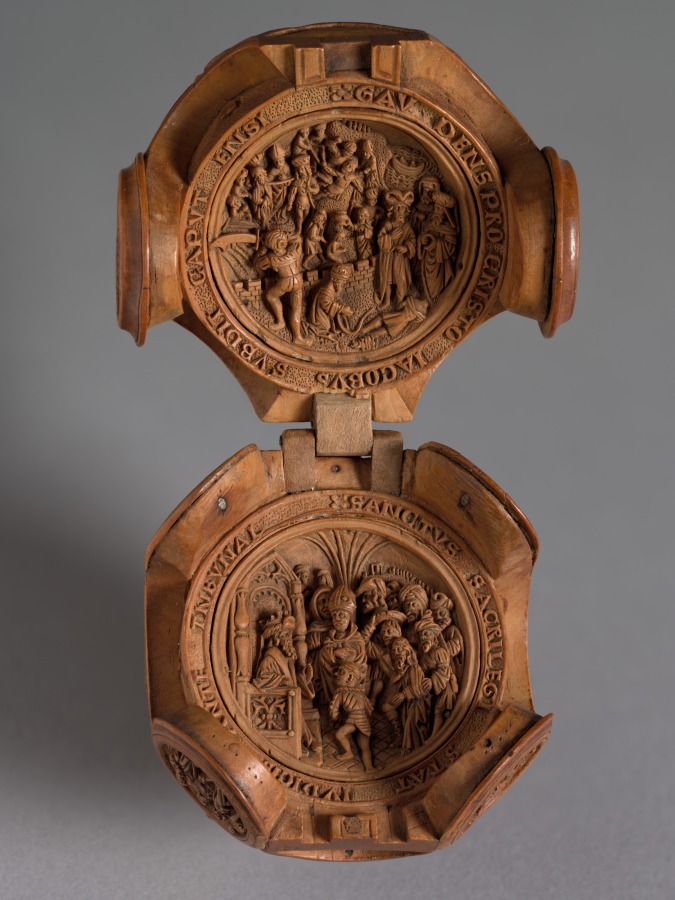
Prayer Nut with Scenes from the Life of St. James the Greater
by Adam Dircksz
Also known as: Paternoster Bead
About the Artwork
Prayer nuts are capsules that can be opened in half and were mainly worn from the end of the 1400s until 1530, particularly in the Netherlands. These objects are generally made from boxwood and carved with extreme refinement and delicacy. They often echo Gothic architecture and include openwork tracery or elaborate decorative patterns. Prayer nuts came into fashion for private devotion as a pendant on the rosary or on a decorative chain. The emergence of prayer nuts went hand in hand with the practice of praying the rosary more frequently at the end of the Middle Ages.
Inscriptions
Interior around lower half: SANCTVS SACRILEGI STAT IVDICIS ANTE TRIBVNAL (Holiness stands before the throne of the profane judge); Interior, around upper half: GAVDENS PRO CRISTO IACOBVS SVBDIT CAPVT ENSI (St James submits his head to the sword)
Exhibition history
Year in Review (1961). The Cleveland Museum of Art, Cleveland, OH (organizer) (November 1-26, 1961). Small Wonders: Gothic Boxwood Miniatures. Art Gallery of Ontario, Ontario M5T 1G4, Canada (organizer) (November 5, 2016-January 22, 2017); The Metropolitan Museum of Art, New York, NY (February 15-May 15, 2017).
Quick Overview
- Artist
- Adam Dircksz (Netherlandish, active c. 1500)
- Date
- c. 1500–1530
- Medium
- boxwood
- Dimensions
- Overall: 5.8 x 4.8 cm (2 5/16 x 1 7/8 in.)
- Type
- Sculpture
- Classification
- Sculpture
- Department
- Medieval Art
- Credit line
- Purchase from the J. H. Wade Fund
- Accession no.
- 1961.87
Provenance
The Cleveland Museum of Art’s open-access data does not include an ownership history for this work. See the museum’s page for this work.
Data retrieved from the Cleveland Museum of Art on October 8, 2026. The museum may have updated its record since.
Open-access museum record · AT-00010661
Request removalPowered by Art Trackers