
Public data from the Cleveland Museum of Art. Learn more
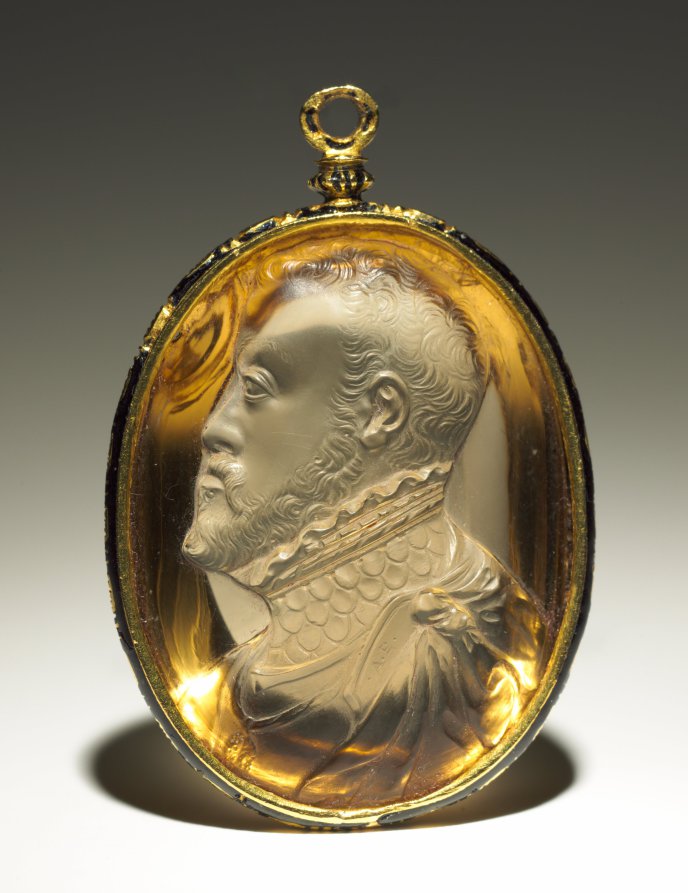
Portrait of Philip II, King of Spain
About the Artwork
Clad in armor, Philip II wears a chain with the Order of Golden Fleece around his neck. The remarkably precise and varied cutting describes the textures of cloth, metal, skin, and hair while presenting the king’s features with striking naturalism—complete with receding hairline and prominent chin—as well as conveying his forceful character. Carved gems were luxury arts of the highest order in the Renaissance, hotly collected and used as diplomatic gifts. The original patron is not yet known, but cameos played a prominent role at the Spanish court, where the royal family often hold gems of Philip II in their portraits. The yellow quartz, rare in the 1500s, probably came from a newly opened source in South America; this object is thus both a natural marvel and a masterful portrait. One of only three known works signed by the artist (his initials appear at miniscule scale on the collar just below the knot of cloth), this stone is also likely in its original setting.
Inscriptions
Signed on collar .A.E. (Likely abbreviation for “ΑΛΕΞΑΝΔΡΟΣ ΕΠΟΙΕΙ”, or “Alexandros Epoiei,” which translates to “Alexander made [me / this].”)
Quick Overview
- Artist
- Alessandro Cesati (Italian, before 1538-after 1564)
- Date
- mid-1550s
- Medium
- citrine, mounted in a gold and enamel pendant
- Dimensions
- Pendant: 4.3 x 2.8 x 0.9 cm (1 11/16 x 1 1/8 x 3/8 in.); Gem: 3.2 x 2.5 cm (1 1/4 x 1 in.)
- Type
- Sculpture
- Classification
- Sculpture
- Department
- European Painting and Sculpture
- Credit line
- By exchange: Bequests of Mrs. Severance A. Millikin and John L. Severance; Dudley P. Allen Fund; Gift of Carrie Moss Halle in memory of Salmon Portland Halle; Gift of S. Livingstone Mather, Constance Mather Bishop, Philip R. Mather, Katherine Hoyt Cross,
- Accession no.
- 2012.53
Provenance
1550s: Possibly King Philip II of Spain (1527-1598), possibly by gift to his godson Philip Howard 1550s-1595: Possibly Philip Howard, 20th Earl of Arundel (1557-1595), by inheritance to his son Thomas Howard (1585-1646) 1595-1646: Thomas Howard, 2nd Earl of Arundel (1585-1646), by inheritance to Henry Frederick Howard (1608-1652) 1646-1652: Henry Frederick Howard, Lord Maltravers (1608-1652), by descent to Herny Howard, 7th Duke of Norfolk (1655-1701) 1652-1700: Henry Howard, 7th Duke of Norfolk (1655-1701), by settlement to his divorced Duchess Lady Mary Mordaunt (c. 1659-1705) 1700-1705: Duchess Lady Mary Mordaunt (c. 1659-1705), by inheritance to her second husband Sir John Germain (1650-1718) 1705-1718: Sir John Germain (1650-1718), by inheritance to his second wife Lady Elizabeth Germain (1680-1769) 1718-1762: Lady Elizabeth Germain (1680-1769), by gift to her great niece Lady Mary Beauclerc (1743-1812) on the occasion of her marriage to Lord Charles Spencer (1740-1820), brother of the 3rd duke of Marlborough 1762-: Lord Charles Spencer (1740-1820), by inheritance to Lady Mary Spencer, by family arrangement to her brother-in-law George Spencer (1739-1817) -1817: George Spencer, 4th Duke of Marlborough (1739-1817), by inheritance to George Spencer-Churchill, 5th Duke of Marlborough (1766-1840) 1817-1840: George Spencer-Churchill, 5th Duke of Marlborough (1766-1840), by inheritance to George Spencer-Churchill, 6th Duke of Marlborough (1793-1857) 1840-1857: George Spencer-Churchill, 6th Duke of Marlborough (1793-1857), by inheritance to John Winston Spencer-Churchill (1822-1883) 1857-1875: John Winston Spencer-Churchill, 7th Duke of Marlborough (1822-1883) (sold, Christie's, London, 1875, lot 587, to David Bromilow) 1875-1899: David Bromilow (sold, Christie's, London, June 26, 1899, lot 587 to Francis Whelan for £105) 1899 - before 1930: Francis Whelan Before 1930: Spink and Sons Before 2008: Private collection (sold Bonham's, London, December 2008, for £62,400 to Lowell Libson) 2008-2012: Lowell Libson and Thomas Heneage 2012-: The Cleveland Museum of Art, Cleveland, Ohio
Data retrieved from the Cleveland Museum of Art on October 8, 2026. The museum may have updated its record since.
Open-access museum record · AT-00010686
Request removalPowered by Art Trackers