
Public collection via the Cleveland Museum of Art
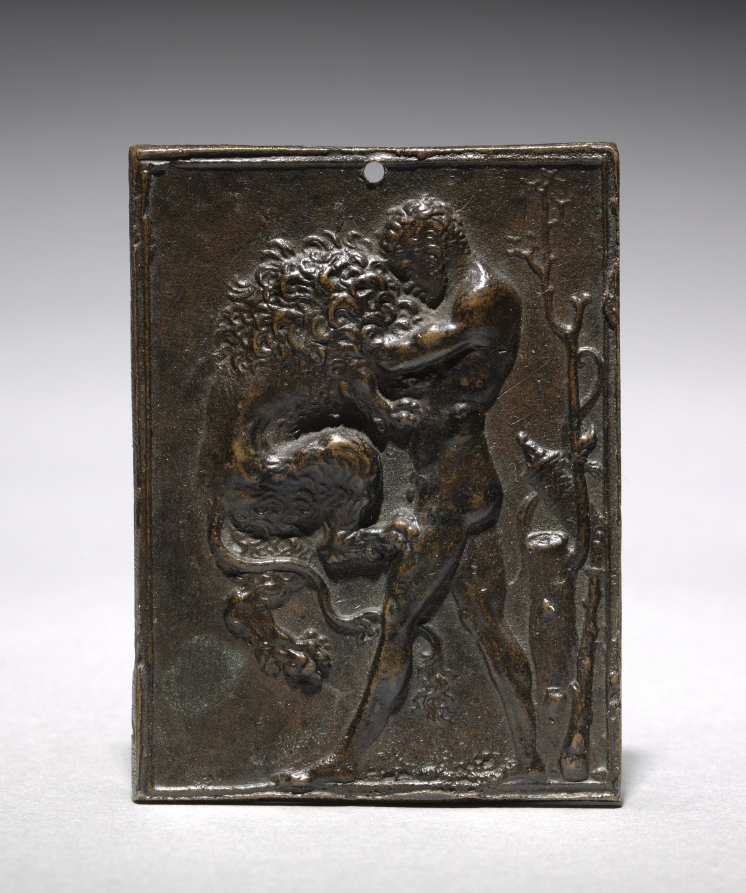
AT-00010763Hercules and the Nemean Lion
by Moderno
About the Artwork
This plaquette by Moderno, a Northern Italian sculptor active in the early 1500s, displays the ancient subject of Hercules wrestling the Nemean lion. The subject of this plaquette finds its origins in the ancient myth of the Twelve Labors of Hercules, a popular theme during the Renaissance. After killing his wife and child in a fit of rage, Hercules was sent by an oracle to be punished by King Eurystheus of Tiryns. The King presented Hercules with twelve challenges, the first of which was to kill the Nemean lion. Twice as large as a normal lion, it had an impenetrable hide, symbolic of the uncontrollability of nature. Hercules tracked the lion to its cave, and after failing to kill it with the arrows of Apollo, Hercules strangled the lion with his bare hands. As Hercules' strength allowed him to defeat the lion, the myth expresses human dominance over nature. Hercules then used the lion's razor-sharp claws to remove its skin and returned to King Eurystheus wearing the impenetrable skin as protection. To honor the lion's struggle against Hercules, Zeus transformed the lion into the constellation Leo. In this scene, the nude Hercules stands in profile facing left with his left foot resting on the plaquette's lower border. The plaquette has no background other than a barren tree against which rest Hercules's club and Apollo's quiver and bow. The lion rests its rear paw on Hercules' thigh as Hercules lifts the lion off of the ground. The lion's body and mane consists of stylized tufts of fur which contrast with the smooth, naturalistic form of Hercules' body. The minute, short curling lines of the hair and mane create a rhythmic effect while the smooth curves of the forms place an emphasis on contour-this contrast of visual rhythm with smooth form is in fact characteristic of Moderno's bronze relief sculpture. The composition meanwhile has its origin in ancient Greek coins as well as Renaissance cameos.
Provenance
J. P. Heseltine, died 1929 (London, England), upon his death, held in trust by the estate Estate of J.P. Heseltine (sold, Sotheby's, London, May 1935, lot 933) Adda (sold, Palais Galliera, Paris, November 29 to December 3, 1965, lot 283); Alavoine Antiquities (Paris, France), sold to the Cleveland Museum of Art, 1967.
Exhibition history
Year in Review: 1967. The Cleveland Museum of Art, Cleveland, OH (organizer) (November 29-December 31, 1967). A Cleveland Bestiary. The Cleveland Museum of Art, Cleveland, OH (organizer) (October 15-December 16, 1981). Collecting Drawings in England. The Cleveland Museum of Art, Cleveland, OH (organizer) (November 3, 1987-January 17, 1988). The Persistence of Classicism in Sculpture. The Cleveland Museum of Art, Cleveland, OH (organizer) (November 16, 1988-January 15, 1989). Gods and Heroes: Ancient Legends in Renaissance Art. The Cleveland Museum of Art, Cleveland, OH (organizer) (August 26-December 31, 2017).
Data retrieved from the Cleveland Museum of Art on October 8, 2026. The museum may have updated its record since.
Quick Overview
- Artist
- Moderno (Italian, 1467–1528)
- Date
- 1500s
- Medium
- bronze
- Dimensions
- Overall: 7.6 x 5.7 cm (3 x 2 1/4 in.)
- Type
- Sculpture
- Classification
- Sculpture
- Department
- European Painting and Sculpture
- Credit line
- Sundry Purchase Fund
- Accession no.
- 1967.135
More by Moderno in museum collections
Open-access museum record · AT-00010763
Powered by Art Trackers