
Public data from the Cleveland Museum of Art. Learn more
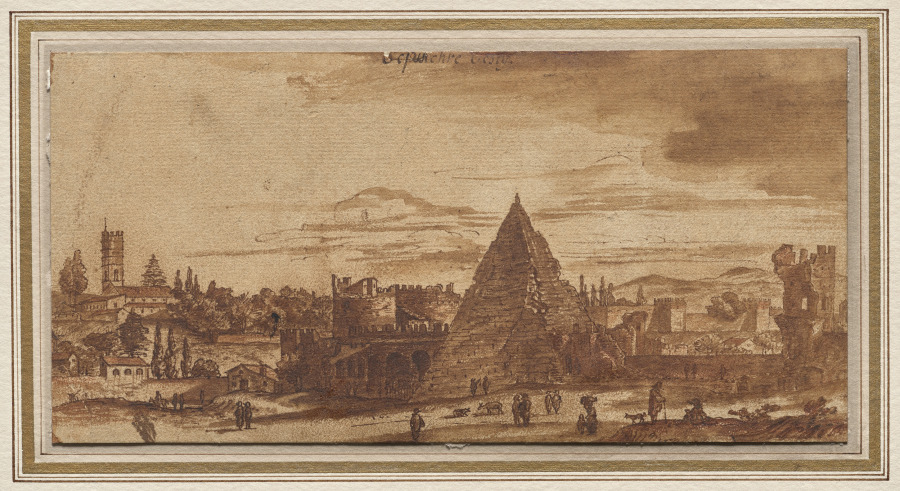
The Pyramid of Cestius, Rome
About the Artwork
The Dutch artist Michiel Van Overbeek drew The Pyramid of Cestius, Rome from southwest of the site, looking toward the 12 BC Pyramid of Cestius, and the 3rd- to 4th-century Porta Ostiensis (Porta Santo Paulo). The Egyptian structure in the Roman countryside attracted many tourists, and artists, for its singularity within the Roman architectural landscape. The careful attention given to the rise of the land at left, with small abodes tucked into the hills, and the crumbling ruin at the right, suggest that Van Overbeek wanted to record the scene as accurately as possible.
Inscriptions
Inscribed u.m. Sepulchre Cesty, initialled l.r. M.V.O. del[?]
Provenance
?-1854?: Possibly with Samuel Woodburn, London; his sale, Christie's London, June 16, 1854, lot 115, "M. Van Overbeck / Views of the principal buildings in Rome--a set of ten." January 14, 1969: (Mak van Waay, Netherlands) May 13, 1972: Herbert Lark Private Collection, Southwest England (P. & D. Colnaghi, London, England) ?-2021: (Nonesuch Gallery, London, England) September 13, 2021-: The Cleveland Museum of Art, Cleveland, OH
Quick Overview
- Artist
- Michiel van Overbeek (Dutch, active 1663–1709)
- Date
- c. 1650–80
- Medium
- Pen and brown ink with red chalk on brown prepared paper
- Dimensions
- Support: 18.1 x 28.3 cm (7 1/8 x 11 1/8 in.); Matted: 21.9 x 30.5 cm (8 5/8 x 12 in.); Image: 9.9 x 20 cm (3 7/8 x 7 7/8 in.)
- Type
- Drawing
- Classification
- Drawing
- Department
- Drawings
- Credit line
- Mr. and Mrs. Richard W. Whitehill Art Purchase Endowment Fund
- Accession no.
- 2021.144
Data retrieved from the Cleveland Museum of Art on October 8, 2026. The museum may have updated its record since.
Open-access museum record · AT-00011231
Powered by Art Trackers