
Public data from the Cleveland Museum of Art. Learn more
Abu Simbel
About the Artwork
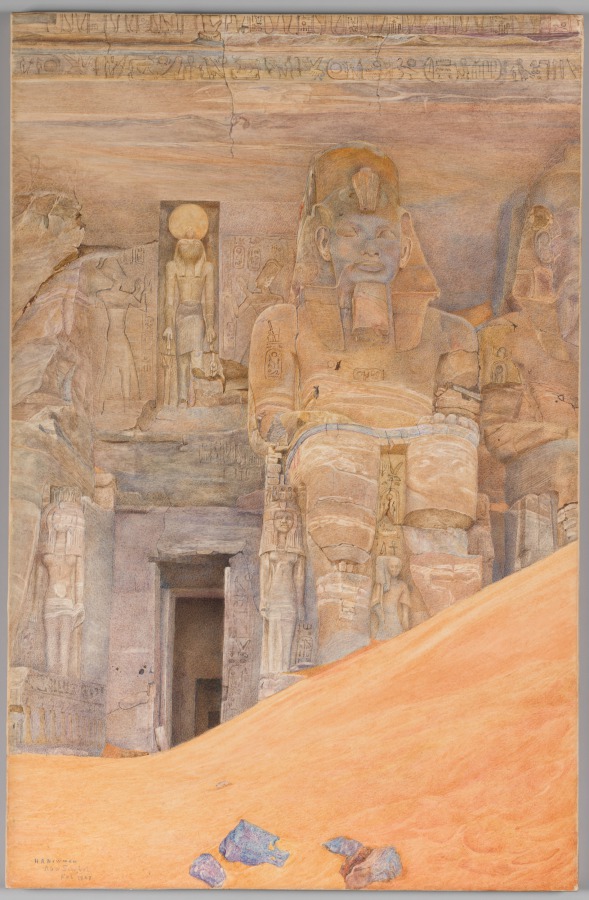
This watercolor provides a close-up view of the Abu Simbel temples, which were buried in sand until their rediscovery in the 19th century. The American artist Henry Roderick Newman portrayed their architecture in multiple drawings between 1894 and 1913. In this later work, he meticulously layered dots and other marks to capture the tonality of sand and desert light.
Inscriptions
lower left, in blue watercolor: H R Newman / Abu Simbel / Feb. 1907; verso: in graphite on wooden panel, below the horizontal support: Abu Simbel / 1907 / This picture must not (must and not underlined twice) be removed / from the panel (be removed from the panel: each word underlined once) / HRN; upper right, in graphite: 66050; purple black stamp below horizontal crossbar and just below the inscription: CHARLES ROBERSON & Co / ARTISTS’ COLOURMEN / Manufacturers of / WATER & OIL COLOURS, / MATERIALS FOR / Drawing & Painting. / 99, LONG ACRE, LONDON
Provenance
H. Wunderlich & Co., New York, NY May 22, 1996: Sotheby's, New York, NY 1996-2018: William Kelly Simpson, Katonah, NY June 4, 2018: the Cleveland Museum of Art, Cleveland, OH
Quick Overview
- Artist
- Henry Roderick Newman (American, 1833–1918)
- Date
- 1907
- Medium
- watercolor
- Dimensions
- Image: 66 x 43 x 1.3 cm (26 x 16 15/16 x 1/2 in.)
- Type
- Drawing
- Classification
- Drawing
- Department
- Drawings
- Credit line
- Bequest of William Kelly Simpson
- Accession no.
- 2018.72
Data retrieved from the Cleveland Museum of Art on October 8, 2026. The museum may have updated its record since.
Open-access museum record · AT-00011700
Powered by Art Trackers