
Public data from the Cleveland Museum of Art. Learn more
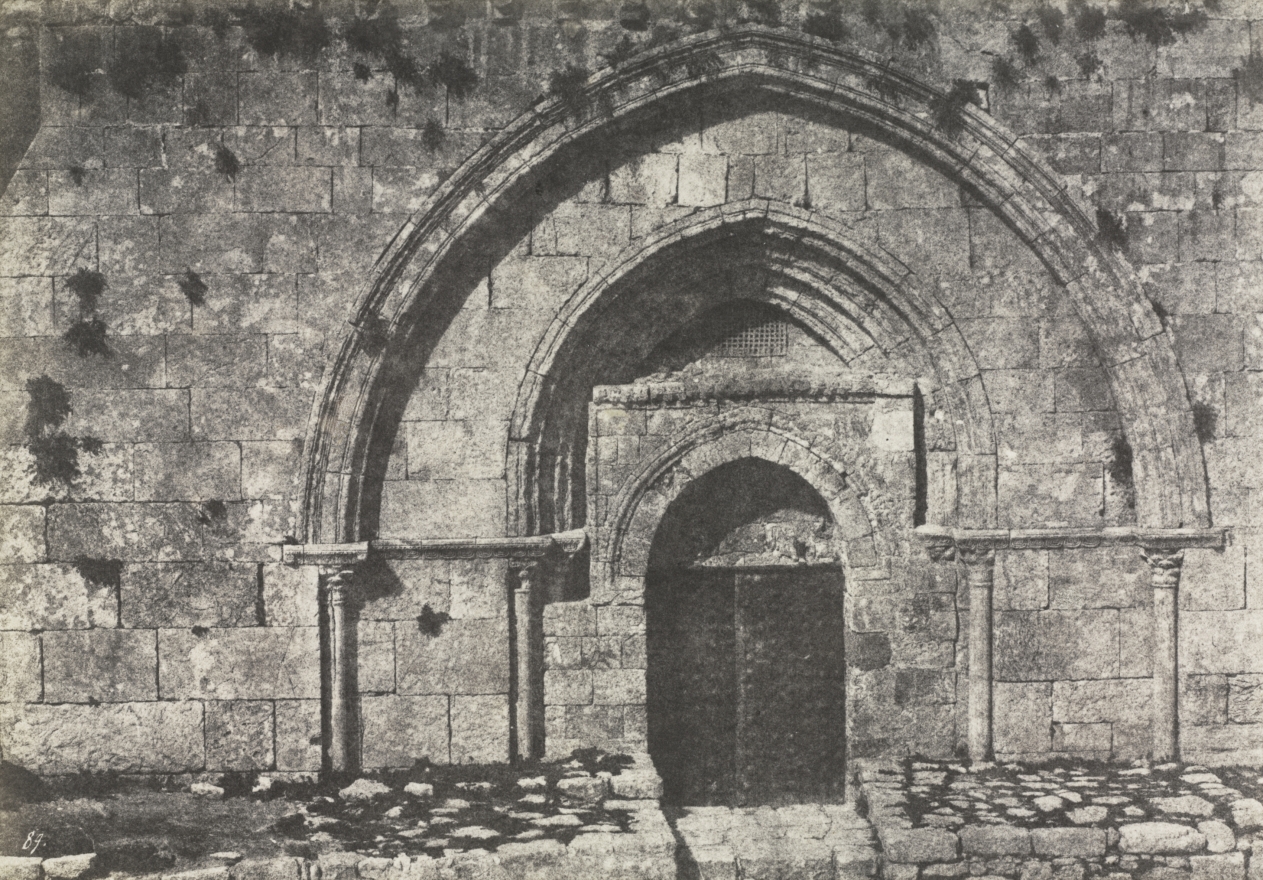
Tomb of the Virgin, Jerusalem
About the Artwork
In 1854, Auguste Salzmann was commissioned by the French Ministry of Public Instruction to document the holy city of Jerusalem. His charge was to substantiate the controversial theories about dating ancient ruins proposed by his friend, Louis Félicien de Saulcy, a noted antiquarian. Unlike almost all other photographers documenting architecture in the 19th century, Salzmann relied on extreme close-up views. In this example, he eliminated most of the building, concentrating on the door of the tomb and its surrounding architectural elements. As a result, all indications of scale, terrain, placement, and context normally found in documentary photographs are absent, while the abstract textural and surface qualities of the tomb are emphasized.
Inscriptions
Written in negative: "89"; in pencil on verso: "4011"
Quick Overview
- Artist
- Auguste Salzmann (French, 1824–1872)
- Date
- 1854
- Medium
- salted paper print, Blanquart-Évrard process, from waxed paper negative
- Dimensions
- Image: 22.7 x 32.8 cm (8 15/16 x 12 15/16 in.); Matted: 50.8 x 61 cm (20 x 24 in.)
- Type
- Photograph
- Classification
- Photograph
- Department
- Photography
- Credit line
- John L. Severance Fund
- Accession no.
- 1996.10
Provenance
(Charles Isaacs Photographs, Inc., New York, NY) March 4, 1996: The Cleveland Museum of Art, Cleveland, OH
More by Auguste Salzmann in museum collections


Jerusalem, Valley of Josaphat, Tomb of St. James (Jérusalem, Vallée de Josaphat, Tombeau de Saint Jacques)
Auguste Salzmann1854, printed 1856 · Photograph

Jerusalem, Church of the Holy Sepulchre (Jérusalem, Saint-Sépulcre)
Auguste Salzmann1854/56 · Photograph

Data retrieved from the Cleveland Museum of Art on October 8, 2026. The museum may have updated its record since.
Open-access museum record · AT-00013008
Request removalPowered by Art Trackers