
Public collection via the Cleveland Museum of Art
AT-00013015Dawn and Sunset
About the Artwork
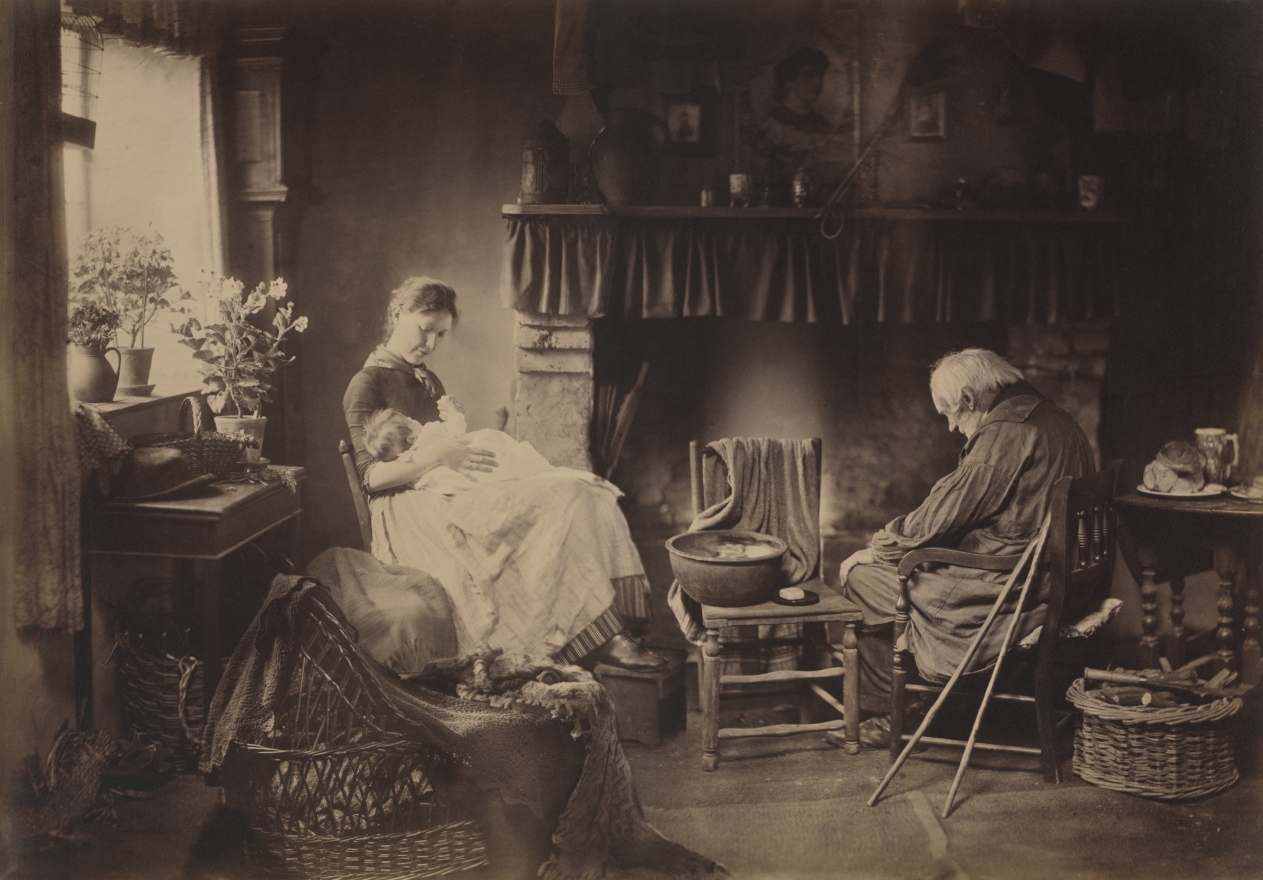
Henry Peach Robinson was a pioneer in the "combination printing" technique, employing a number of negatives to make one photographic print. Keenly interested in portraying picturesque narrative scenes and landscapes, he carefully staged elaborate tableaux, often relying on relatives to serve as models. In Dawn and Sunset he presented a symbolic portrayal of three generations, from infancy to old age. By using the combination method, he was able to exercise greater control over his subjects' poses, gestures, and expressions than would have been possible with a single exposure. The smaller, platinum print version provides an instructive example of how an artist's vision can change when a different process is used to print the same negative. The platinum process provided a warmer, more subtle tonal range than the albumen process. The larger, albumen print appears almost journalistic in its use of harsh, even lighting, whereas in the platinum print Robinson was able to hide many details in dark shadow. This created a sense of unity that is missing in the larger image.
Exhibition history
Beyond Truth: Photography after the Shutter. The Cleveland Museum of Art, Cleveland, OH (organizer) (February 10-May 26, 2019).
Data retrieved from the Cleveland Museum of Art on October 8, 2026. The museum may have updated its record since.
Quick Overview
- Artist
- Henry Peach Robinson (British, 1830–1901)
- Date
- 1885
- Medium
- albumen print from three negatives
- Dimensions
- Image: 54.5 x 78 cm (21 7/16 x 30 11/16 in.); Mounted: 61 x 85.8 cm (24 x 33 3/4 in.); Matted: 76.2 x 101.6 cm (30 x 40 in.)
- Type
- Photograph
- Classification
- Photograph
- Department
- Photography
- Credit line
- Purchase from the J. H. Wade Fund
- Accession no.
- 1998.107
More by Henry Peach Robinson in museum collections


Open-access museum record · AT-00013015
Powered by Art Trackers