
Public collection via the Cleveland Museum of Art
AT-00013067Still Life with Statuary and Drapery
About the Artwork
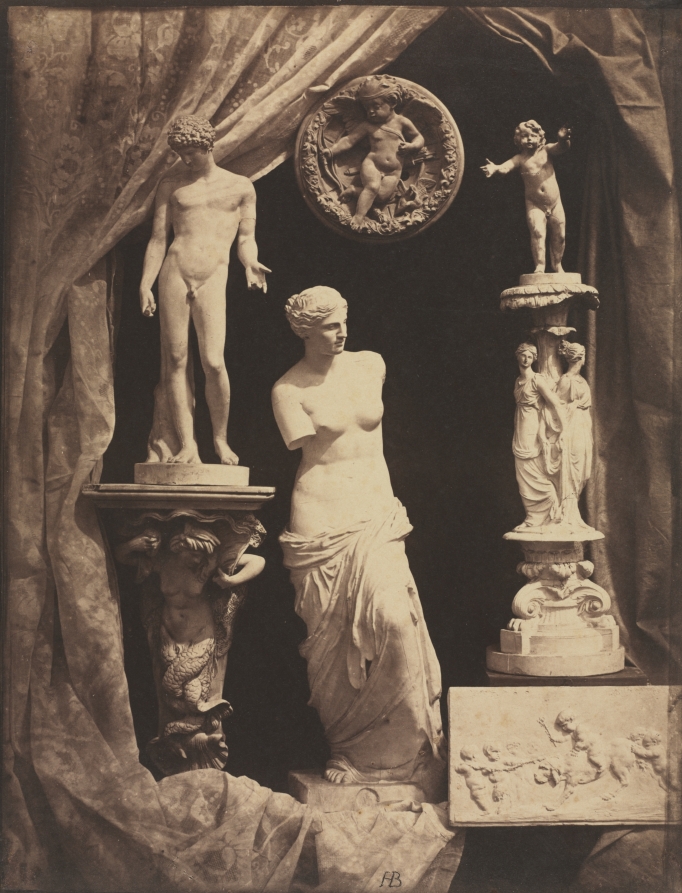
Unlike his contemporaries, Bayard was fascinated with ancient Greco-Roman statuary. From his inventory of over forty examples, he created a captivating still life of plaster casts that affirms his technical proficiency and sensitivity to subject matter. Bright, natural light illuminates the figures and bas reliefs. Their three-dimensionality is emphasized by the stark contrast of their white surfaces with the dark background. The composition is also embellished with gracefully flowing draperies, which frame the scene. Bayard appears not to have had any formal artistic or scientific training, but was a key figure and talented inventor in the early history of photography. Although his contributions were initially ignored, he went on to become a distinguished member of the photographic community in Paris. This rare print from a wet collodion negative is the outcome of Bayard's experimentation with the direct paper positive process, which he began around 1839.
Inscriptions
inscribed in negative on recto: "HB"
Data retrieved from the Cleveland Museum of Art on October 8, 2026. The museum may have updated its record since.
Quick Overview
- Artist
- Hippolyte Bayard (French, 1801–1887)
- Date
- c. 1850
- Medium
- albumenized salt print from wet collodion negative
- Dimensions
- Image: 26.6 x 20.6 cm (10 1/2 x 8 1/8 in.); Mounted: 34.9 x 27.2 cm (13 3/4 x 10 11/16 in.); Matted: 50.8 x 40.6 cm (20 x 16 in.)
- Type
- Photograph
- Classification
- Photograph
- Department
- Photography
- Credit line
- John L. Severance Fund
- Accession no.
- 1999.50
More by Hippolyte Bayard in museum collections


Open-access museum record · AT-00013067
Powered by Art Trackers