
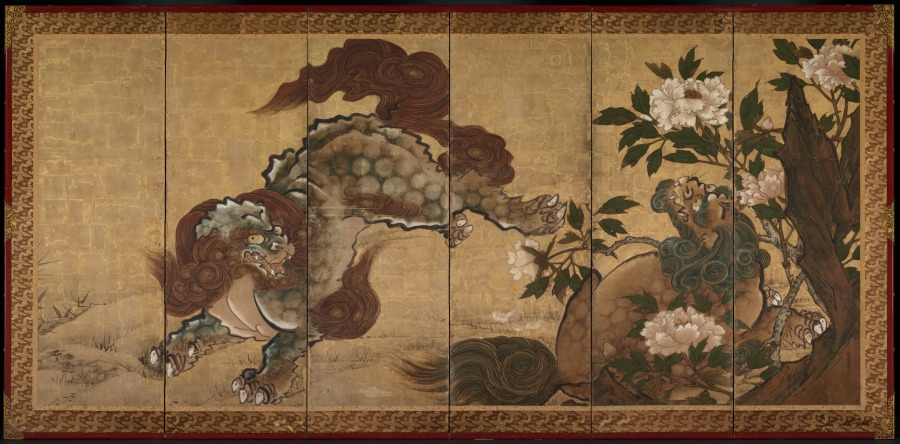
Public collection via the Cleveland Museum of Art
AT-00009998Lions and Tigers in Peony and Bamboo
About the Artwork
Sekkei lived and studied painting in Kyoto at the Kano school studio, the center of traditional painting activity in Japan since 1500. The use of gold foil as a backdrop for the frolicking animals served a practical as well as a decorative function. Because traditional Japanese rooms had no windows, interior lighting came from portable oil lamps and wax candles, whose effects were magnified by reflective surfaces.
Provenance
?–1972: (Nisaburo Mizutani, Kyoto, Japan, sold to the Cleveland Museum of Art) 1972–: The Cleveland Museum of Art, Cleveland, OH
Exhibition history
Japanese Screens from the Museum and Cleveland Collections. The Cleveland Museum of Art, Cleveland, OH (organizer) (March 23-May 8, 1977). Unfolding Beauty: Japanese Screens from the Cleveland Museum of Art. The Cleveland Museum of Art, Cleveland, OH (organizer) (July 15-September 16, 2001).
Data retrieved from the Cleveland Museum of Art on October 8, 2026. The museum may have updated its record since.
Quick Overview
- Artist
- Yamaguchi Sekkei (Japanese, 1644–1732)
- Date
- 1668
- Medium
- One of a pair of six-panel folding screens; ink and color on gilded paper
- Dimensions
- Image: 149 x 330 cm (58 11/16 x 129 15/16 in.)
- Type
- Painting
- Classification
- Painting
- Department
- Japanese Art
- Credit line
- John L. Severance Fund
- Accession no.
- 1972.10.1
More by Yamaguchi Sekkei in museum collections


Open-access museum record · AT-00009998
Powered by Art Trackers