ART TRACKERSConnecting fine art to people
Platform OverviewPlatform SecurityPricingTechnology OverviewTags & PlaquesWhat is UAINLegal & Compliance
GovernmentTribal NationsArtistsUniversity & CollegesServicesProcurement
InstitutionsExploreMuseum Collections
Artists
Why Art TrackersAboutContactBlogDocumentationCareers
Request demo
Platform OverviewPlatform SecurityPricingTechnology OverviewTags & PlaquesWhat is UAINLegal & Compliance
GovernmentTribal NationsArtistsUniversity & CollegesServicesProcurement
InstitutionsExploreMuseum Collections
Artists
Why Art TrackersAboutContactBlogDocumentationCareers
Request demo
Art Trackers logo
ART TRACKERS
Connecting fine art to people

Connecting fine art to people. Preserving cultural legacy through technology.

Platform

FeaturesHow It WorksSecurityIntegrations

Government

For Cities & CountiesCompliance

Resources

DocumentationHelp CenterBlog

Company

About UsCareersNewsContact Us

© 2026 Art Trackers LLC. All rights reserved.

Privacy PolicyTerms of ServiceAccessibility
    Museum collections / The Cleveland Museum of Art
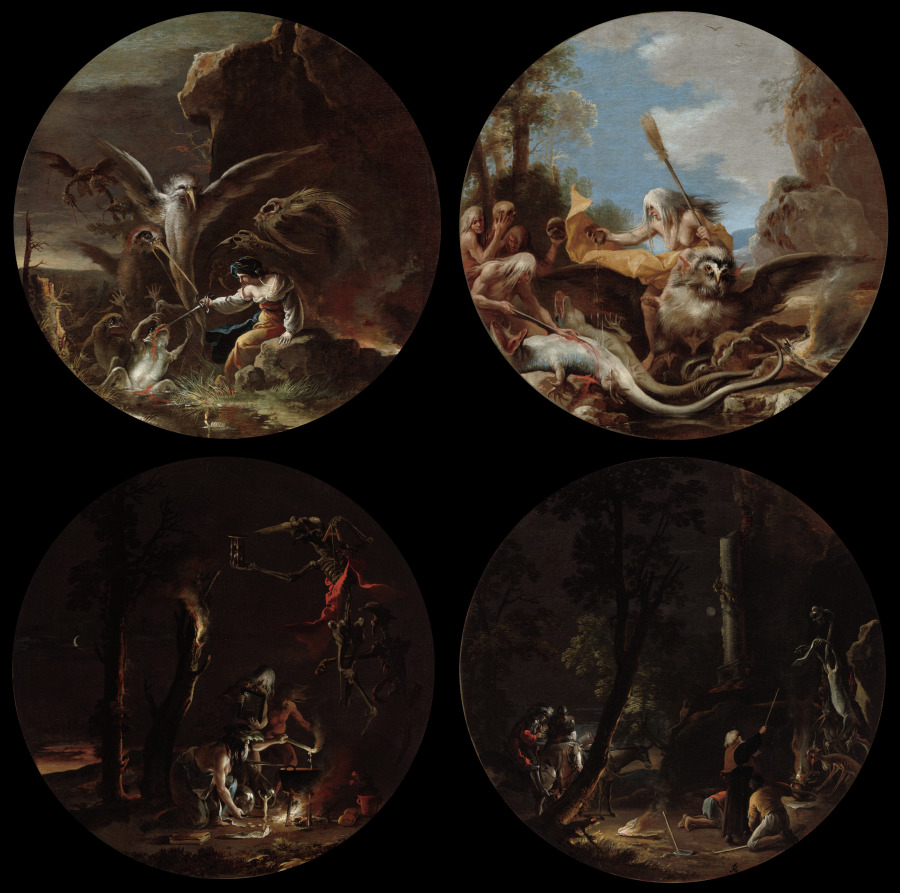
    Scenes of Witchcraft by Salvator Rosa
    Salvator Rosa. Scenes of Witchcraft, c. 1645–49. The Cleveland Museum of Art. Public domain (CC0).
    AT-00009311

    Public data from the Cleveland Museum of Art. Learn more

    Scenes of Witchcraft

    by Salvator Rosa

    Also known as: Scene with Witches: Morning, Day, Evening, Night; Witches Scenes

    About the Artwork

    A huge upturn in interest in witchcraft emerged during the 1500s in Europe, but by the middle of the next century—at least among the cultured elite of Florence—a backlash arose against the many accusations of sorcery. Artists and writers explored the topic more out of curiosity and amusement, chief among them the poet, painter, and satirist Salvator Rosa, who examined witchcraft with gusto in numerous poems and works of art, including these four paintings. They show a range witch types, from the beautiful enchantress to the old crone to the male sorcerer, and represent activities commonly associated with black magic: levitation, love potions, devil worship, the invocation of demons, and transformation. A common subject in Italian art of the 1600s, transformation was usually seen in interpretations of myths based on Ovid's ancient Latin text, the Metamophoses. Rosa found a novel way to exploit this idea, drawing attention to his own ability to transform paint and canvas into a disturbing, nightmarish world.

    Inscriptions

    Signed: "SR [monogram]"

    Exhibition history

    Year in Review: 1977. The Cleveland Museum of Art, Cleveland, OH (organizer) (December 28, 1977-January 22, 1978). Baroque Imagery. The Cleveland Museum of Art, Cleveland, OH (organizer) (November 6, 1984-January 6, 1985).

    Quick Overview

    Artist
    Salvator Rosa (Italian, 1615–1673)
    Date
    c. 1645–49
    Medium
    oil on canvas
    Dimensions
    Framed: 76.2 x 9.6 cm (30 x 3 3/4 in.); Unframed: 54.5 cm (21 7/16 in.)
    Type
    Painting
    Classification
    Painting
    Department
    European Painting and Sculpture
    Credit line
    Purchase from the J. H. Wade Fund
    Accession no.
    1977.37

    Provenance

    by 1967: Niccolini Family (Florence, Italy). Private collection (Florence, Italy). 1977: Heim Gallery (London, England), sold to the Cleveland Museum of Art.

    More by Salvator Rosa in museum collections

    • Polycrates and the Fisherman by Salvator Rosa

      Polycrates and the Fisherman

      Salvator Rosa

      1664 · Painting

      Museum collection · via the Art Institute of ChicagoAT-00000982
    • Polycrates' Crucifixion by Salvator Rosa

      Polycrates' Crucifixion

      Salvator Rosa

      1664 · Painting

      Museum collection · via the Art Institute of ChicagoAT-00000983
    • Man Mounting Lion by Salvator Rosa

      Man Mounting Lion

      Salvator Rosa

      n.d. · Drawing

      Museum collection · via the Art Institute of ChicagoAT-00004185
    • Three Soldiers Resting by Salvator Rosa

      Three Soldiers Resting

      Salvator Rosa

      1656/57 · Drawing

      Museum collection · via the Art Institute of ChicagoAT-00005737

    Open-access museum data

    This record comes from the open-access collection data that the Cleveland Museum of Art publishes for unrestricted use (Creative Commons Zero). Art Trackers shows a selection of the museum's published fields. The Cleveland Museum of Art is not an Art Trackers client and has not reviewed or endorsed this page; the museum's own website is the authoritative record.

    Source: The Cleveland Museum of Art Open Access (CC0)

    • View this work at the Cleveland Museum of Art
    • The Cleveland Museum of Art: open-access terms

    Data retrieved from the Cleveland Museum of Art on October 8, 2026. The museum may have updated its record since.

    Open-access museum record · AT-00009311

    Request removal·Powered by Art Trackers